




Related news
How to Make Rubber Boots with Neoprene Lining: Material, Process, and Benefits
1. Introduction
In the footwear and outdoor‑gear market, the demand for high‑performance boots continues to rise. Particularly notable are rubber boots with neoprene lining which combine waterproof protection, insulation and comfort. For retailers, wholesalers and brand owners seeking reliable supply chains, understanding the material composition, manufacturing process and end‑use applications is essential.
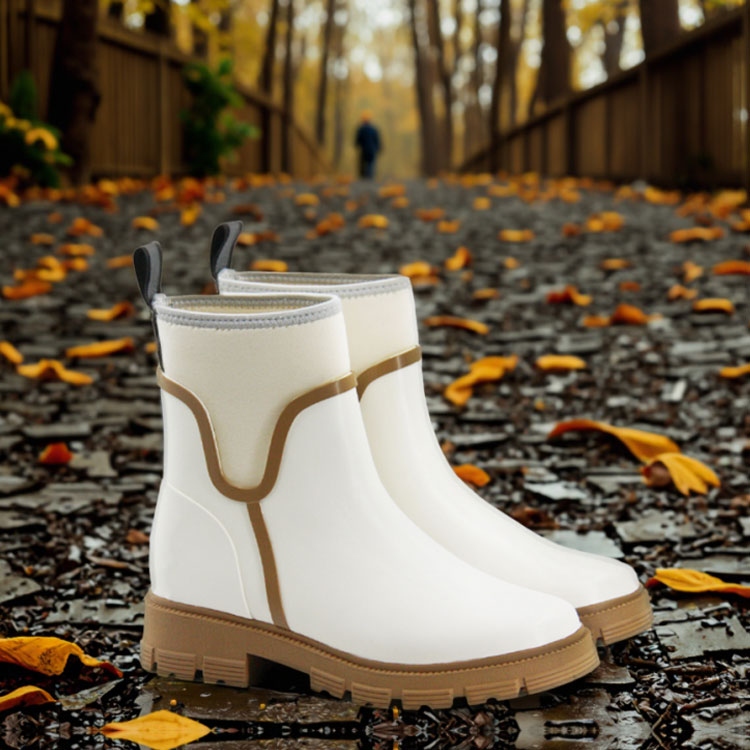
2. What is neoprene and why does it matter for rubber‑boot construction
Neoprene (polychloroprene) is a synthetic rubber originally developed in the early 1930s. Its relevance to boot construction stems from key properties: waterproofness, insulation, flexibility and resistance to outdoor elements.
2.1 Material basics
Neoprene is produced by the emulsion polymerisation of chloroprene.
When foamed into a closed‑cell structure (or used as a sock lining), it provides thermal insulation and a barrier to water ingress.
In boot construction, the combination of neoprene lining (or sock) plus an outer rubber shell creates a composite that benefits from both flexibility and durability.
2.2 Neoprene in “neoprene lined rubber boots”
A patent document describes a boot construction where a neoprene sock is formed first (floor region + upper region) and then covered by an outer rubber layer, bonded and vulcanised.
The patent emphasises advantages: lighter weight (30 % lighter in some embodiments), improved fit, improved resiliency.
From a sourcing viewpoint, specifying the neoprene thickness, type (closed-cell foam versus solid), bonding to the rubber shell, and inspection of vulcanisation quality are all critical.
2.3 Why this matters for business clients
Retailers or wholesales brands seeking best neoprene rubber boots or neoprene rubber boots manufacturers must ensure that the inner neoprene sock is well‑constructed, that the outer rubber shell fully covers and bonds to the neoprene, and that the finishing (seals, joints, outsole attachment) is robust.
The term rubber boots with neoprene top often implies the neoprene lining or sock rises to the top edge of the boot, providing insulation along the shaft as well as the foot base. The patent supports this design.
For the “waterproof insulated rubber neoprene outdoor boots” segment, emphasising insulation, waterproofing, and outdoor durability is key.
Manufacturing process of neoprene‑lined rubber boots
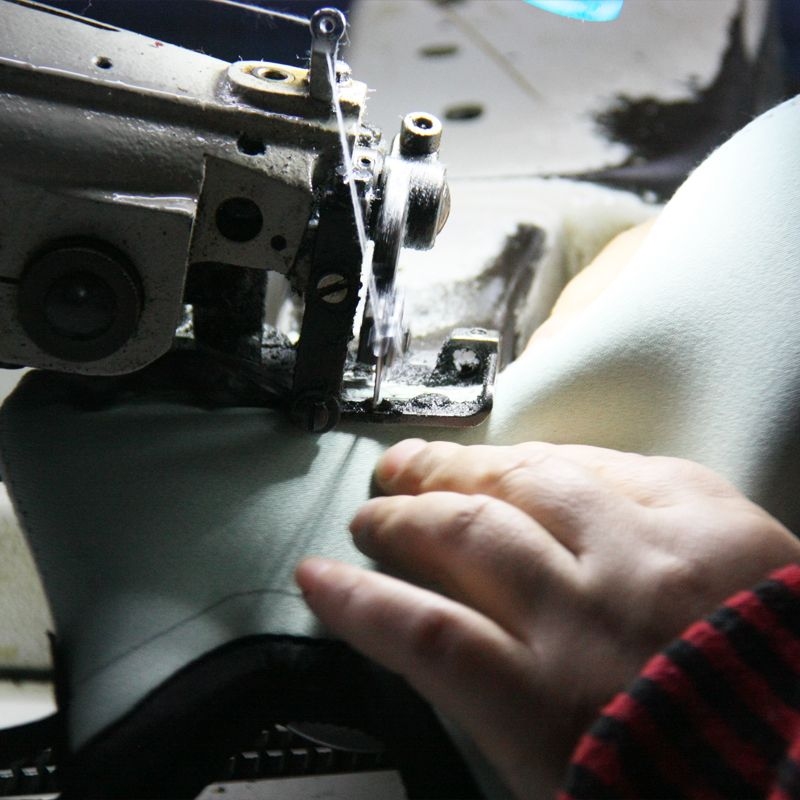
Understanding how boots with neoprene lining are made helps business clients evaluate manufacturing capability, quality control and cost drivers.
3.1 Step‑by‑step overview
Based on several industry sources:
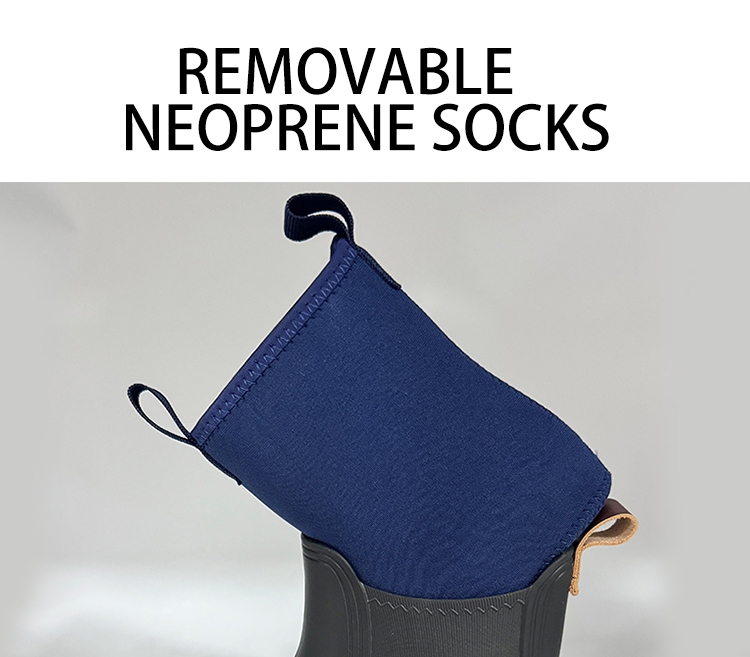
Sock formation: A neoprene “sock” is stitched or sewn together (floor + upper region), creating the interior liner. For example, a maker mentions: “the sock is wrapped around a metal foot, called a ‘last’ … then the outer rubber upper is wrapped around the neoprene sock.”
Lasting and assembly of rubber shell: The neoprene sock is placed over the last (metal form) then rubber pieces or sheets are cut and glued/overlaid around the sock. The rubber pieces may cover both the upper region and floor region of the neoprene.
Bonding and vulcanisation: The rubber sheets and the neoprene sock are then vulcanised (heat + pressure) to form a bonded composite that integrates the neoprene liner and the rubber outer shell.
Outsole attachment, finishing and testing: After the upper and inner liner are secured, the outsole (often rubber or a lighter midsole like EVA) is attached, the boot is trimmed, back‑join sealed, and the finished boot is tested for waterproofing, bonding integrity, flexing, etc.
3.2 Key technical sourcing considerations
Neoprene sock construction: Thickness, closed‑cell versus open‑cell foam, stitching quality, quality of fleece or inner lining attached to the neoprene.
Bonding between neoprene and rubber shell: Adequate adhesive/ cement, control of vulcanisation temperature/time, layering and rubber sheet thickness. The patent suggests the outer rubber layer may be about 0.030 in (~0.76 mm) and neoprene layer about 3 mm + fleece 1.5 mm in one case.
Rubber shell compound: The type of rubber (natural, SBR, or blended), whether additives or fillers (e.g., calcium carbonate) reduce performance. A handbook warns that compromise in rubber compounds often causes failure of the boot.
Waterproof sealing and finishing: Even well‑made boots may fail if seams are weak, or outsole attachment is poorly bonded.
Weight and comfort: The neoprene‑rubber composite offers lighter weight and better fit than older all‑rubber boots. From a sourcing perspective, weight targets, fit profiles and comfort performance are increasingly demanded by end users in outdoor segments.
4. Material and performance benefits of neoprene lined rubber boots
From a materials and performance viewpoint, boots with neoprene lining offer several benefits which are relevant to retailers and brand owners positioning in the market.
4.1 Waterproofing and protection
The outer rubber shell provides strong waterproofness, resistance to mud, rain, snow or wet environments.
The neoprene liner further enhances waterproof integrity because the inner sock is continuous and helps prevent seepage through stitching or overlays. The patent emphasises a construction where the neoprene sock is completely covered by the rubber layer to achieve a continuous waterproof barrier.
For outdoor boots used for hunting, riding, snow and rain – the combination of rubber shell + neoprene liner is particularly relevant.
4.2 Thermal insulation and comfort
Neoprene’s closed‑cell foam structure provides thermal insulation (trapping air, resisting cold).
The fit of neoprene liner around the foot reduces dead‑space, improving heat retention and comfort.
The lighter weight (versus heavy all‑rubber boots) means less fatigue for the user – a selling point in longer outdoor use.
4.3 Fit and flexibility
The patent and industry sources highlight that the neoprene‑rubber composite allows greater flexibility (rolling of shaft, better fit) than older rigid rubber boots.
Increased fit precision leads to better wearer experience, fewer fit‑related returns for retailers.
4.4 Durability and performance in demanding settings
Welded or vulcanised bonding between neoprene and rubber helps durability.
For retail/wholesale brands entering “best neoprene rubber boots” market, this is key: durability, weatherproofing, thermal comfort.
The industry handbook emphasises that many problems in rubber boots stem from low‑quality materials, lack of specification, and superficial sourcing.
5. Market applications and target segments
For business clients (retailers, wholesale brands) considering sourcing such boots, it’s useful to understand where the product finds traction.
5.1 Outdoor and lifestyle segments
Boots with neoprene lining are popular in hunting, hiking, riding, snow conditions, heavy rain and cold‑weather environments.
They also appear in fashion‑wearing segments where waterproof / insulated boots with rubber + neoprene offer style plus functional performance.
5.2 Retail positioning: “rubber boots with neoprene top” & “neoprene lined rubber boots”
The phrase “rubber boots with neoprene top” can signal that the neoprene liner extends up the shaft (top) of the boot, which increases insulation along the leg – important in snow or wet terrain.
The term “neoprene lined rubber boots” communicates the dual‑material benefit (rubber exterior + neoprene interior) and supports premium pricing or performance positioning.
5.3 Wholesale/OEM/ODM opportunities
Brands that want to offer private‑label or OEM/ODM boots in this niche need to partner with manufacturers capable of neoprene‑rubber composite processes.
Key considerations: factory capability for neoprene sock stitching, overlay rubberisation, vulcanisation, quality control, waterproof testing.
For example, a manufacturer might offer customization: bespoke neoprene thickness, custom rubber shell colour/texture, outsole design, branding/embossing.
5.4 Sourcing for cost‑performance balance
The materials (neoprene, rubber compounds, adhesives) are more expensive than basic rubber boots, so cost control is important.
Quality specification (neoprene type, rubber compound, bonding) must be explicit in sourcing documents to avoid future failures—a caution raised in industry textbooks.
Retail clients should request and audit quality test reports: waterproof testing, flex‑crack testing, bonding strength, outsole adhesion, abrasion resistance.
6. What retailers/brands should specify when sourcing from neoprene rubber boots manufacturers
Business clients should include detailed technical and specification criteria to ensure product performance and supply‑chain reliability. Below is a checklist of key specification elements:
Neoprene sock: foam type (closed‑cell foam SBR or CR), thickness (e.g., 3 mm neoprene + fleece layer 1.5 mm as in one patent example)
Sock construction: seams, stitching quality, sock wrap over last steps, fit around metal last.
Rubber outer shell: material type (natural rubber vs SBR vs synthetic blend), sheet thickness, overlays, toe/heel double layers for reinforcement.
Bonding process: adhesive type (water‑based, solvent), application method, coverage, rubber sheet application onto neoprene sock and floor region (as per patent).
Lasting and moulding process: lasting over last, trimming, back‑join sealing, rubber band strip at back.
Vulcanisation: temperature/time autoclave or equivalent process to ensure rubber‑neoprene bond, composite integrity.
Outsole attachment: glue type, cured bond, outsole material (rubber or EVA midsole), attachment method.
Sealing and waterproofing: sealing of stitching lines, overlays, boots tested for waterproof ingress.
Testing and QC: flex‑crack testing, abrasion resistance, outsole bond testing, waterproof testing, user environment simulation. Refer to industry handbook for recommended test protocols.
Fit, weight, comfort: benchmark weight targets, fit tolerance, liner comfort (neoprene), shaft flexibility.
Branding/ODM elements: custom sock colour or fleece liner, rubber shell colour/printing, outsole tread design, packaging, labelling.
Compliance and documentation: material certification (e.g., neoprene supplier, rubber compound), testing certificates, factory audit, sample approval.
Choose Trenboo as your neoprene‑lined rubber boots ODM/OEM manufacturer
For brands, retailers and wholesale buyers seeking a reliable partner with ODM/OEM capability in high‑performance neoprene‑lined rubber boots, Trenboo offers comprehensive ODM/OEM solutions.
With dedicated factory infrastructure, sample‑approval workflow and comprehensive product range (rubber boots with neoprene lining, customizable designs, robust production and finishing lines), Trenboo is positioned to support private‑label and brand‑name manufacturing for global markets.
With a state-of-the-art facility producing 150,000 pairs monthly and full customization from design sketches to vulcanized soles, contact Trenboo today to elevate production with guaranteed quality, eco-compliance, and on-time delivery.

 consult
 WHATSAPP
 leave message
 top
top