





Related news
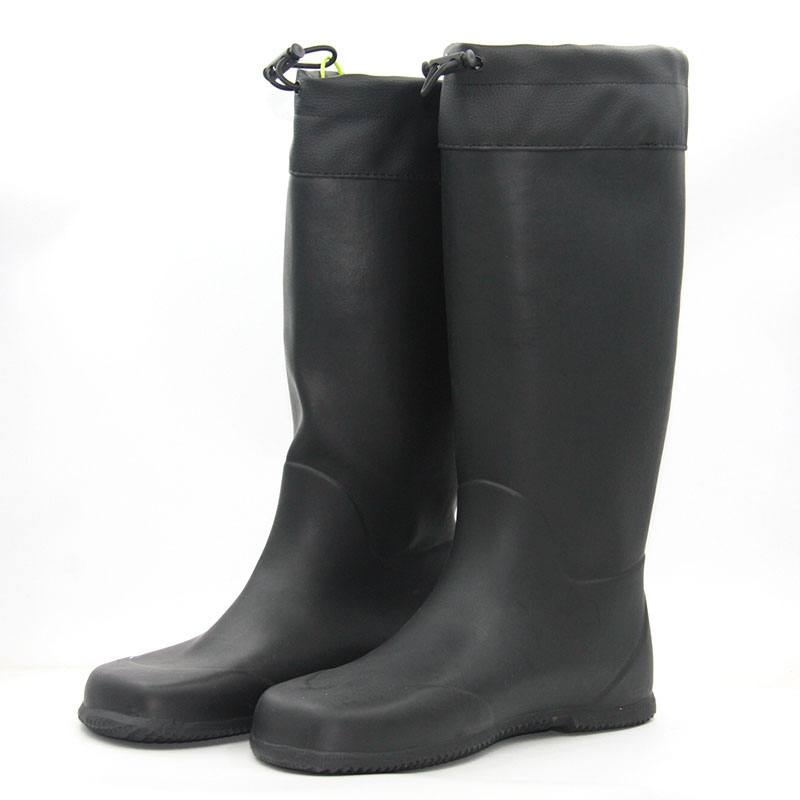

Why Choose Injection Molded PVC and EVA Rain Boots for the Low-Cost Market Segment?
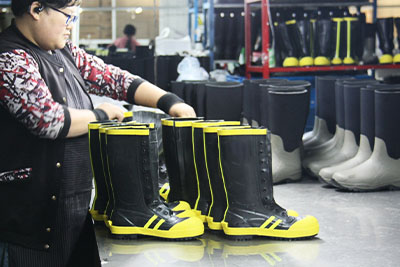
Injection molded rain boots made from PVC or EVA have become the main choice for cheap yet strong waterproof footwear around the world. The one-body injection molding process pushes hot liquid polymer straight into a complete boot-shaped mold. It creates a smooth, single-piece item in just one automatic step. This removes weak spots that come from putting parts together—like glued seams, stitched areas, or attached soles. At the same time, it supports very high output levels with really low costs per unit. In a time with more extreme weather, changing raw material prices, and tough rivalry in low-price shoe markets, these boots give wholesalers, distributors, importers, and private-label brands a strong mix of dependability, growth potential, and good profits. Click here for the video watching.
Understanding the One-Body Injection Molding Process for Rain Boots
How the Injection Molding Cycle Works in Rain Boot Production
Production starts with large rotary injection machines that have 12 to 36 stations or even more. PVC compound pellets get softened at 160–200°C. EVA needs milder heat (often 120–160°C) to keep the chemical blowing agents safe. These agents form its typical light foam build. The hot material goes in at pressures from 800–1500 bar into very accurate molds. These molds are usually high-grade aluminum for quick heat loss or steel for longer production runs.
Cycle times normally run 60–120 seconds per pair on well-set lines. This lets one machine make 500–2,000 pairs per shift based on setup. Cooling happens fast through built-in water paths. It hardens the boot before automatic removal from the mold. EVA’s expansion stage takes place during or right after injection. It builds closed-cell foam that gives natural padding without extra insoles. This automatic and steady process keeps thickness even and cuts material waste to a minimum.
Key Differences in PVC and EVA Processing Parameters
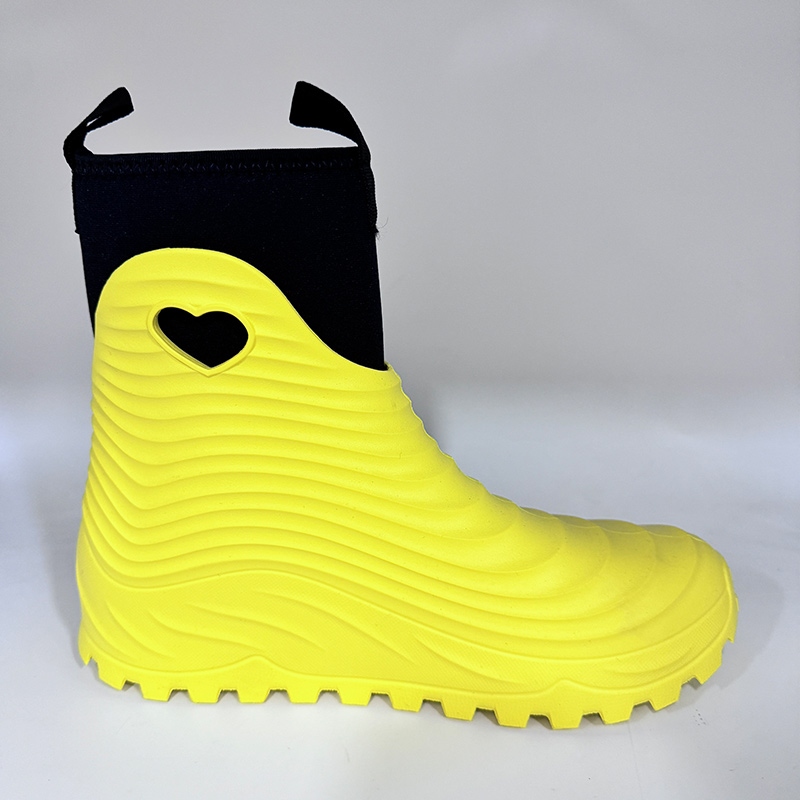
PVC gives great flow for complex tread designs and fine surface details. But its bigger shrinkage rate (1.5–2.5%) calls for careful mold adjustments and even cooling to stop warping. EVA processing focuses on exact control of blowing agent action and gas holding. Too much expansion leads to blowouts or uneven thickness. Too little makes heavy and stiff boots. Multi-color or multi-density injection—often seen on modern machines—lets makers create two- or three-tone looks or soft midsoles with hard outsoles in one go. This cuts extra steps and allows fun designs on a large scale.
Core Production Advantages Over Traditional Handmade or Cemented Rain Boots
Superior Efficiency and Labor Cost Reduction
Injection molding needs only 3–8 operators per line compared to 20–50 for handmade or cemented methods at the same output. This 70–90% drop in labor brings much lower costs in places sensitive to wages. It makes big production runs practical even at factory prices under $5.
Seamless Construction Eliminates Common Failure Points
Cemented rain boots often break at the sole-to-upper join because glue fails from water damage, constant bending, or contact with oils and cleaners. One-body molding builds a nonstop molecular form with no joins. It spreads stress evenly and almost removes risks of layers coming apart.
Unmatched Waterproof Performance and Durability
No seams, stitch holes, or glue lines means full waterproof quality. This is often checked with 24-hour water tests or pressure leak checks. In real situations—puddles, mud, farm chemicals—these boots hold up much longer than put-together types. They lower warranty problems and build trust for B2B buyers.
Cost Predictability and Supply Chain Resilience
PVC and EVA come from petrochemical sources and show steady prices unlike natural rubber. Natural rubber faces big swings in latex supply due to weather in Southeast Asia. This steady cost helps with long-term planning and guards profits during price jumps or trade issues.
Material Breakdown: PVC vs. EVA in Injection Molded Rain Boots
PVC Rain Boots: Strengths in Rugged, Chemical-Resistant Applications
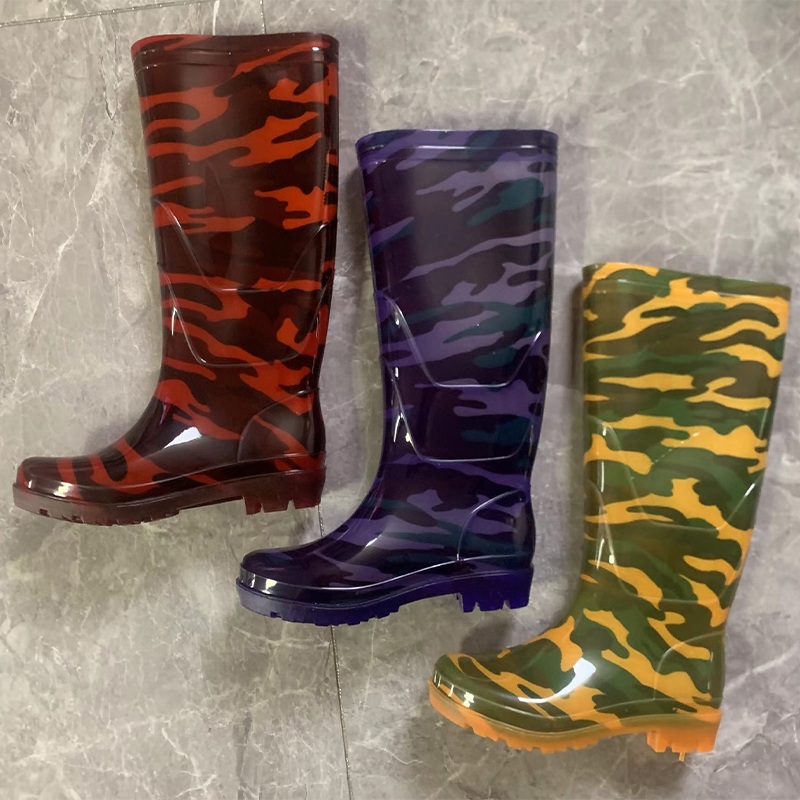
High-density PVC mixes provide better wear resistance, puncture protection, and chemical safety against fertilizers, pesticides, fuels, and industrial cleaners. PVC Boots keep their shape from -10°C to 50°C. This makes them the top pick for construction, farming, and fishing areas where toughness matters more than light weight.
EVA Rain Boots: Advantages in Lightweight Comfort and Flexibility
With densities as low as 0.3–0.6 g/cm³, EVA boots weigh 30–50% less than PVC ones. Many come in under 800 grams per pair. The tiny-cell foam build takes in shocks, fits foot motion, and gives warmth in cold conditions. Small air passage from the cells helps control inside moisture better than solid PVC.
Durability and Sustainability Nuances Between PVC and EVA
PVC leads in tear strength and cut protection for dangerous settings. Yet EVA shows better resistance to repeated bending over millions of cycles thanks to its bounce-back ability. For sustainability, EVA now often uses recycled material or plant-based sources with little loss in quality. This helps it meet new producer responsibility rules in Europe and North America.
Addressing Common Challenges and Defects in Injection Production
Preventing Short Shots and Incomplete Filling
Incomplete filling in long calf or shaft parts comes from low pressure, too thick material, or poor venting. Fixes include multi-gate setups for even flow, additives to adjust thickness, and live pressure sensors for quick changes.
Eliminating Sink Marks in Thicker Zones
Thicker heel and ankle areas cool more slowly and cause surface dips. Ways to fix this include core-back methods (small mold opening while cooling), gas-assisted injection for empty sections, and fine-tuned packing pressure settings.
Controlling Flash and Warpage Issues
Flash happens when clamp force is too weak against injection pressure or when mold edges wear. Warpage comes from uneven shrinkage. Prevention uses balanced mold cooling, stress-relief heating after removal, and additives that lower crystal differences.
Advanced Solutions for Burn Marks, Voids, and Silver Streaks
Trapped air leads to burn marks from diesel effect. Better multi-point venting and vacuum injection reduce this. Silver streaks from wet pellets are stopped with strict pre-drying (usually 2–4 hours at 70–80°C). In general, Industry 4.0 tools like cavity pressure checks and predictive upkeep keep defect rates below 0.5%.
Market Dynamics and Strategic Positioning in the Low-Cost Segment
Rising Demand Driven by Climate Variability and Utility Applications
More frequent heavy rain, floods, and all-year wet seasons in Asia, Africa, and Latin America drive steady growth. Injection molding’s quick lead times (often 30–45 days from order to delivery) allow fast reaction to sudden demand increases.
Positioning for High-Volume Sales and Customization Opportunities
Low defect rates, standard shapes, and cheap custom touches (embossing, screen printing, color matching) make these boots perfect for big retail, promo goods, workwear programs, and private-label lines. Hybrid builds—EVA main parts with PVC strengthened toes or soles—give special value without big cost jumps.
Emerging Trends Toward Sustainability, Automation, and Smart Manufacturing
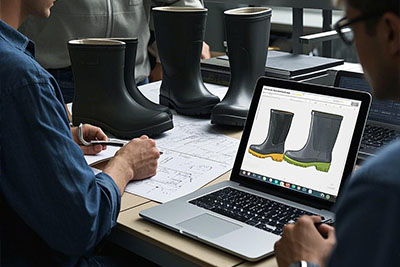
Electric and hybrid injection presses cut energy use by 30–60% compared to hydraulic ones. They also improve consistency from shot to shot. Recycled PVC/EVA mixes and phthalate-free stabilizers meet rules and buyer demands. Smart factories now use digital twins for mold testing. This shortens time to create new styles.
Business Sourcing Considerations for Injection Molded Rain Boots
Choosing partners means checking machine age, mold accuracy, compound knowledge, and full quality systems (ISO 9001, BSCI, chemical testing). Good OEM/ODM skills help fast prototypes, size ranges (EU 34–48, US kids to adult), and extras like removable liners, reflective strips, or better grip compounds.
Frequently Asked Questions (FAQs)
What is the main difference between PVC and EVA injection molded rain boots?
PVC rain boots provide superior chemical resistance, puncture protection, and rigidity, making them ideal for industrial or agricultural use in harsh environments. EVA rain boots prioritize extreme lightness (often 30–50% lighter), flexibility, and natural cushioning, offering better all-day comfort and thermal insulation for casual or mobility-focused applications.
Are injection molded PVC and EVA rain boots truly 100% waterproof?
Yes, the one-piece seamless design eliminates joints, seams, glue lines, or stitch holes that could allow water ingress. This monolithic structure ensures reliable waterproof performance even under prolonged submersion or high-pressure exposure, far surpassing many traditional assembled rain boots.
Which material is more durable for long-term use in demanding conditions?
PVC generally offers better tear strength, abrasion resistance, and chemical inertness for rugged, sharp-object, or solvent-exposed settings. EVA excels in fatigue resistance under repeated flexing and maintains cushioning longer in high-mobility scenarios, though it may be more prone to punctures without reinforcements.
Partner with Trenboo for Reliable High-Volume Rain Boot Production
Businesses seeking dependable, high-volume production of injection molded PVC and EVA rain boots should partner with Trenboo for specialized waterproof footwear manufacturing. Trenboo delivers advanced injection capabilities, comprehensive OEM/ODM services, strict quality controls, and tailored solutions for international clients. Explore extensive product lines, detailed factory capabilities, and customization options—then contact the team directly at https://www.trenboot.com/ to request samples, discuss specifications, or obtain competitive quotations for your next project.

 consult
 WHATSAPP
 leave message
 top
top