


Verwandte Nachrichten


Rubber Safety Boots Supplier: EN ISO 20345 & ASTM Buying Guide
A waterproof rubber boot is not automatically safety footwear. For brands, importers and industrial distributors, classification should be confirmed before tooling, sampling or quotation because water resistance, toe protection, puncture resistance, slip performance and electrical properties are separate requirements.

Match the Boot to the Market
EN ISO 20345:2022 is the principal EU safety-footwear standard. Rubber and fully molded polymeric boots are generally Class II footwear; S4 is a key category, while S5 adds penetration resistance and a cleated outsole.
In the United States, ASTM F2413 covers protective-toe footwear, but waterproofness requires a separate test specification. Canada, Australia, New Zealand and Japan also apply their own standards, markings and documentation.
Buyers should therefore define the destination market, application, hazard level, required standard edition and test methods before product development. A general statement such as “waterproof safety boot” is not enough for tender comparison or compliance approval.
Buyer Note: Materials, Design and Use
Material selection should reflect the intended sales channel and working environment. Natural-rubber uppers provide flexibility and waterproof construction for fashion, garden and outdoor wellies. Neoprene, fleece, artificial fur, cotton-polyester or recycled linings can add warmth, comfort or seasonal positioning.
Safety programs may require a certified toe cap, puncture-resistant insert, reinforced outsole and additional resistance to chemicals, cold temperatures or oily surfaces.
The shoe last, boot height, calf width, outsole pattern and rubber thickness also affect fit, weight, traction and durability. These specifications should be frozen before formal testing because changing the outsole, toe cap, rubber compound, lining or construction may invalidate earlier results.
For private-label development, buyers can review Trenboo’s OEM/ODM rubber boot process before preparing a technical brief.
Informationen zum Beschaffungsvertrauen
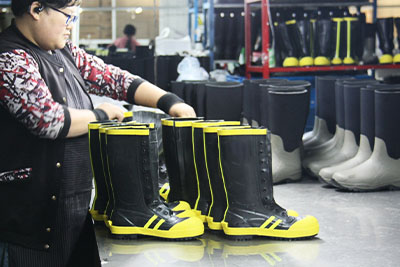
Trenboo identifies its production company as Handan Trendy Boot and Textile Co., Ltd., a vulcanized rubber boot factory in Hebei, China. The company states that its manufacturing history began in 1958 and its export business started in 1999.
Its website lists:
- A 20,000 m² factory
- More than 260 office and production employees
- Six Wellington boot production lines
- Approximately 5,000 pairs of daily capacity
- Approximately 150,000 pairs of monthly capacity
- Exports to more than 50 countries
Published factory qualifications include ISO 9001 quality-management certification and BSCI social-responsibility certification. Trenboo also states that it uses GRS-certified recycled fabrics and FSC-certified shoe boxes for relevant projects and supports EU REACH-oriented production.
Quality control covers material inspection, online assembly inspection, leak testing after vulcanization, packaging-line inspection and final AQL 2.5 sampling. Internal testing equipment includes a vulcanization rheometer, tensile tester and flexing tester.
Buyers should still request current certificates, model-specific laboratory reports, approved component records and pre-shipment inspection documents before confirming a bulk order.
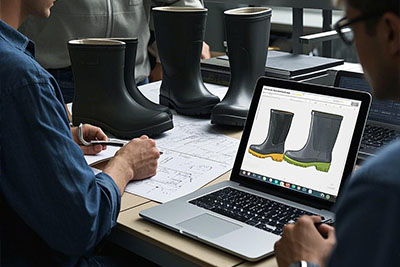
The stated customization target is an initial sample in approximately 15 days, followed by revisions when required. Mass production is generally planned within about 45 days after final sample approval, purchase order and deposit, depending on tooling, materials, order volume and season.
For after-sales support, Trenboo states that it assists with logistics, repairs or replaces defects identified during production control, and compensates qualifying supplier-caused sales returns at FOB value. Purchase contracts should define the claim period, required evidence, available remedy and responsibility for freight.

OEM/ODM Purchasing Decisions
Trenboo’s standard MOQ is generally 800 pairs per color per style, including the available size range. Buyers requiring lower quantities should confirm feasibility before sampling.
Exclusive colors, new shoe lasts, outsole molds, printed uppers or special materials may increase the MOQ, tooling cost and development time.
Customizable items can include:
- Rubber compound and upper thickness
- Shoe last, shaft height and calf width
- Vulcanized rubber, calendered rubber, EVA or hybrid outsoles
- Neoprene, fleece, fur, mesh or textile linings
- Pantone colors, prints, textures and surface finishes
- Toe caps, midsoles, insoles, pull tabs, gussets and straps
- Retail packaging, barcodes and export carton marks
Logo options may include molded or embossed logos, printed or heat-transfer graphics, outsole branding, upper patches, top-band branding, pull-tab labels, insole marks and packaging artwork.
The logo method should be evaluated according to durability, appearance, tooling cost, MOQ and consistency across repeat orders.
Packaging can range from PP bags and master cartons to branded shoe boxes, kraft boxes, tissue paper, hangtags, care cards, size labels and barcode stickers. Industrial programs usually prioritize shipping efficiency, while retail and e-commerce programs require shelf-ready presentation and accurate SKU labeling.
Sample Approval and Bulk-Order Control
A practical sample process should include:
- Confirm the application and destination market.
- Select the shoe last and outsole.
- Approve materials, components and safety features.
- Define Pantone colors, logos and packaging.
- Review sample cost and lead time.
- Check fit, waterproofness, outsole grip, dimensions and appearance.
- Sign and retain a golden sample before mass production.
For bulk orders, the purchase specification should also define size ratios, color tolerance, component suppliers, packaging details, inspection level, acceptable defects, testing obligations, shipment terms and engineering-change approval.
Any change to the toe cap, outsole compound, puncture-resistant insert, lining or bonding process should be reviewed before production continues.
Verwandte Produkte zur Lieferantenbewertung
Buyers can compare different Trenboo categories according to market positioning and end use.
Kids wellies for children’s retail and private-label collections can include handles, colorful prints, seasonal linings and easy-clean constructions.
Adult outdoor wellies for gardening, farming, fishing and hunting include neoprene, insulated, wide-calf and anti-slip designs for different outdoor environments.
Foldable rain boots for travel, camping and portable outdoor ranges emphasize flexibility and packability.
Women’s fashion wellies for private-label lifestyle collections include Chelsea, ankle, mid-calf and tall silhouettes with customizable colors, linings and branding.
Rubber safety and work boot options should be evaluated against the required toe protection, penetration resistance, slip performance, waterproof testing and permanent marking—not appearance alone.
These product pages allow procurement teams to compare materials, size ranges, construction, MOQ and customization possibilities before requesting samples or quotations.
Start a Compliance-Ready Rubber Boot Project
A successful rubber boot program should move from market requirements to product selection, factory assessment, sample confirmation and controlled bulk production.
Für Projekte im Bereich Regenstiefel unter Eigenmarken können Käufer Folgendes überprüfen: Trenboo’s rubber boot collections, study the OEM/ODM customization process and then use the Kontaktseite to submit the destination market, target style, quantity, size range, materials, logo, packaging and testing requirements.
A detailed RFQ enables the factory to assess tooling, MOQ, sample timing, compliance work and production lead time more accurately—and helps the buyer move from general research to a qualified sourcing decision.

 konsultieren
 Die WhatsApp
 Nachricht hinterlassen
 oben
oben