
Nouvelles connexes


Bottes en néoprène personnalisées pour les acheteurs en gros : adéquation des matériaux, du design et de la demande du marché
Coutume bottes en néoprène Ces chaussures constituent une catégorie pratique pour les acheteurs en gros, les importateurs, les distributeurs d'articles de plein air, les détaillants de fournitures agricoles, les fournisseurs d'articles de pêche, les jardineries et les marques de vêtements de pluie en marque blanche. Ce type de produit allie la protection imperméable du caoutchouc au confort du néoprène, ce qui le rend idéal pour les environnements humides, boueux, froids et les travaux en extérieur. Dans le cadre des achats B2B, le choix du modèle est primordial ; il inclut également la structure des matériaux, la performance de la semelle extérieure, les possibilités de personnalisation, la quantité minimale de commande, l'emballage, le délai de livraison, le contrôle qualité et la fiabilité des commandes répétées.

Demande du marché et positionnement produit B2B
Correspondance des scénarios d'utilisation avec les spécifications de démarrage
Les bottes en néoprène doivent être conçues pour des usages professionnels. Celles destinées au jardinage et à l'agriculture doivent être lavables, en caoutchouc souple, avec une doublure confortable et une bonne adhérence. Celles destinées à la pêche et à la navigation doivent offrir une bonne traction sur le pont, une protection imperméable, un bon maintien de la cheville et être faciles à enfiler. Enfin, celles destinées à la chasse et aux travaux extérieurs nécessitent généralement une tige plus haute, un néoprène plus épais, une semelle extérieure résistante à la boue et une isolation renforcée.
Pour les acheteurs en gros, un modèle unique convient rarement à tous les marchés. Une meilleure stratégie d'approvisionnement consiste à classer les produits par usage : bottes de jardin, bottes de pont, bottes de chasse, bottes agricoles, bottes de sécurité en caoutchouc et bottes en caoutchouc pour les activités de plein air. Cette approche simplifie la planification des produits et optimise les ventes sur différents canaux B2B.
Note à l'attention des acheteurs / Marques et importateurs
Le choix des matériaux, la conception du produit et le développement sur mesure influent directement sur le coût final, la quantité minimale de commande, le positionnement en magasin et le risque lié aux commandes en gros. Le caoutchouc naturel assure une imperméabilité durable. Le néoprène améliore la chaleur, la flexibilité et le confort. Les semelles en EVA ou les semelles profilées permettent de réduire le poids pour une utilisation quotidienne et la marche en ville, tandis que les semelles en caoutchouc vulcanisé moulé sont plus adaptées aux activités de plein air, à la randonnée et aux usages nécessitant une sécurité accrue.
Pour les importateurs et les marques de distributeur, le cahier des charges doit définir le marché cible, le climat, la hauteur de tige, l'adhérence de la semelle extérieure, la doublure, le type de logo, le style d'emballage, les exigences en matière de carton et le volume de commande prévu avant l'échantillonnage. Cela permet à l'usine de calculer les coûts, de vérifier la disponibilité des matériaux et de recommander la solution OEM/ODM la plus adaptée.
Choix des matériaux et de la conception pour les bottes en néoprène sur mesure
Sélection de la tige, de la doublure et de la semelle extérieure
Une botte en néoprène sur mesure associe généralement des feuilles de caoutchouc, une doublure ou des empiècements en néoprène et une semelle extérieure en caoutchouc. L'épaisseur de la tige, le composé de caoutchouc, la texture, la couleur et la finition influencent la perception de la qualité et le coût de production. Une botte d'extérieur mate conviendra mieux aux secteurs de l'agriculture et de la chasse, tandis qu'une finition brillante ou lisse sera plus adaptée aux vêtements de pluie tendance.
Le choix de la doublure dépend de la saison et du marché de destination. Une doublure en néoprène est idéale pour une utilisation extérieure par temps froid et humide. Une doublure en coton ou légère convient aux vêtements de pluie de printemps et d'automne. Une doublure en polaire renforce le confort en hiver. Concernant la semelle extérieure, le choix du type (antidérapant, caoutchouc moulé, caoutchouc calandré, EVA ou semelles décoratives) doit se faire en fonction de l'adhérence, du poids, de la durabilité et du budget.
Conception de logos, d'emballages et de marques privées
Les projets personnalisables peuvent inclure la correspondance des couleurs Pantone, l'impression sur la tige, la texture du caoutchouc, une finition mate ou brillante, un écusson logo, un logo en relief, un logo imprimé, le marquage de la semelle intérieure, une étiquette volante, la boîte à chaussures, le marquage du carton et l'emballage de vente au détail. Le choix du logo doit tenir compte de sa durabilité, de sa visibilité, du coût de l'outillage et de la stabilité de la production.
L'emballage doit être adapté au canal de distribution. Les programmes d'approvisionnement industriel et agricole peuvent utiliser des cartons en vrac pratiques. Les projets de vente au détail et de commerce électronique peuvent nécessiter des boîtes de marque, des étiquettes volantes, des étiquettes à code-barres, des fiches d'entretien et des étiquettes de taille. Pour les projets de bottes de pluie en marque blanche, les acheteurs peuvent consulter les offres de Trenboo. processus de personnalisation OEM/ODM et les collections de bottes en caoutchouc connexes avant de préparer une demande de devis.

Informations sur la confiance en matière d'approvisionnement
Capacités de production et préparation à l'exportation
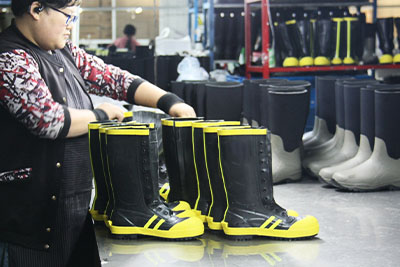
La capacité de production est un facteur clé pour les programmes de bottes de pluie saisonnières. L'usine mentionnée dispose d'une superficie de 20 000 m², emploie plus de 260 personnes, produit 150 000 paires par mois et exporte vers plus de 50 pays. La page dédiée à l'usine indique également la présence de 6 lignes de production de bottes en caoutchouc, d'une capacité d'environ 5 000 paires par jour, de mélangeurs de caoutchouc, de vulcanisateurs et d'équipements de laboratoire tels qu'un rhéomètre de vulcanisation, un appareil de traction et un appareil de flexion.
Pour les acheteurs B2B, ces détails facilitent l'évaluation des fournisseurs en matière de capacité, de contrôle de la production, de tests de qualité et de stabilité à l'exportation.
Certifications, contrôle qualité et assistance
La confiance dans les fournisseurs doit inclure la certification et le contrôle qualité. Les informations relatives à l'usine mentionnent la certification ISO 9001 pour le management de la qualité, la certification BSCI, la conformité au règlement REACH de l'UE, la production de chaussures de sécurité conformes à la norme EU20345 S5, ainsi que les certifications GRS et FSC. Ces points sont particulièrement importants pour les importateurs desservant les marchés européens ou réglementés.
Le contrôle qualité doit inclure l'inspection des matières premières, la vérification de la consistance du mélange de caoutchouc, les tests d'étanchéité, la flexion de la semelle extérieure, la résistance à la traction, la solidité de l'adhérence, le positionnement du logo, l'homogénéité de la couleur, l'inspection de l'emballage et un contrôle avant expédition. Le service après-vente doit comprendre la gestion des retours d'information sur les défauts, la comparaison avec des échantillons de référence, l'amélioration des produits lors des prochaines commandes et l'assistance documentaire pour la production future.
Considérations relatives aux commandes en gros pour les OEM/ODM
Quantité minimale de commande (MOQ), flux d'échantillons et délai de livraison
La quantité minimale de commande (MOQ) dépend de la couleur, du matériau, du logo, de la semelle extérieure, du moule, de l'emballage et de la structure de la commande. La personnalisation avec une couleur de base Pantone peut débuter à partir de 800 paires, tandis que les projets complexes en marque blanche peuvent nécessiter une quantité plus importante selon le style et les matériaux.
Un processus d'échantillonnage professionnel comprend cinq étapes : définir le type de botte en fonction de son utilisation, confirmer la forme et la semelle extérieure, choisir les matériaux des pièces connexes, définir la couleur et le logo, puis obtenir des informations sur le délai et le coût de l'échantillon. Après validation de l'échantillon, les acheteurs doivent confirmer les échantillons de préproduction, les proportions de pointures, le marquage des cartons, les normes d'inspection, les conditions d'expédition et le calendrier de production.
Notes relatives aux commandes groupées
Les commandes en gros nécessitent des dossiers techniques clairs. Une demande de devis complète doit inclure le type de botte, l'usage prévu, le matériau, la doublure, la semelle extérieure, la couleur, le logo, les pointures disponibles, l'emballage, la quantité minimale de commande (MOQ), le marché de destination, les exigences de conformité et le plan de livraison. Pour les importateurs de marques privées, des échantillons approuvés doivent être conservés comme références pour la production et le contrôle final.
Produits associés pour la recherche de produits et l'évaluation des fournisseurs
Bottes pour enfants
Les bottes en caoutchouc pour enfants destinées aux programmes de vente en gros de vêtements de pluie permettent d'étendre un projet de bottes en néoprène aux circuits de distribution familiaux, scolaires, de plein air pour enfants et saisonniers. Parmi les options pratiques, on trouve des poignées faciles à enfiler, des tiges imprimées, des soufflets, des détails réfléchissants et une construction imperméable et légère.
Bottes en caoutchouc d'extérieur pour adultes
Les bottes en caoutchouc pour adultes destinées à l'extérieur, pour la ferme, le jardinage, la chasse et les travaux des champs, conviennent aux distributeurs qui recherchent des bottes résistantes à la boue, offrant un bon maintien du talon, une construction en caoutchouc durable et une adhérence optimale en extérieur. Parmi les options similaires, on trouve des bottes de jardin en néoprène, des bottes de chasse imperméables camouflage, des bottes de pêche et des bottes de travail isolées.
Bottes de pluie pliables
Les bottes de pluie pliables pour les voyages, le camping et les assortiments de vêtements de pluie portables soutiennent les programmes de chaussures imperméables légères où l'efficacité du rangement et la facilité de transport sont importantes.
Bottes en caoutchouc de sécurité
Les bottes de sécurité en caoutchouc et les bottes de travail imperméables et isolées conviennent aux secteurs d'activité industriels, agricoles, de la pêche et aux travaux en milieu humide qui nécessitent une protection renforcée de la semelle extérieure et un positionnement adéquat des vêtements de travail.
Bottes en caoutchouc tendance pour femmes
Les bottes de pluie tendance pour femmes, destinées à la vente au détail de vêtements de pluie lifestyle, peuvent soutenir les collections de marques privées avec des silhouettes Chelsea, des formes mi-mollet, des bottes de pluie à mollet large, des couleurs personnalisées, des imprimés et des emballages de marque.
FAQ (questions fréquentes)
Quel est le MOQ typique pour des bottes en néoprène sur mesure ?
La quantité minimale de commande (MOQ) dépend du matériau, de la couleur, de la semelle extérieure, du logo, de l'emballage et de la nécessité de nouveaux moules. Certaines personnalisations de couleur peuvent être réalisées à partir de 800 paires, tandis que les projets OEM/ODM plus complexes font l'objet d'un devis personnalisé.
Qu'est-ce qui peut être personnalisé ?
Les options de personnalisation comprennent le matériau, l'épaisseur de la tige, le composé de caoutchouc, la hauteur de la tige, la forme de la chaussure, la semelle extérieure, la doublure, la couleur Pantone, l'impression, la texture, le logo, la semelle intérieure, l'étiquette volante, la boîte à chaussures et le marquage du carton.
Quels produits conviennent à un premier lancement en gros ?
Un lancement équilibré peut inclure des bottes de jardin en néoprène, des bottes de pêche sur pont, des bottes de pluie pour la chasse, des bottes en caoutchouc tendance pour femmes, des bottes en caoutchouc pour enfants et des bottes de pluie pliables.
Que faut-il confirmer avant la production en série ?
Les acheteurs doivent confirmer les échantillons approuvés, les spécifications des matériaux, les normes de couleur, la position du logo, le rapport de taille, les fichiers d'emballage, la liste de contrôle d'inspection, le calendrier de livraison et les conditions de paiement.
Pour les projets de bottes de pluie de marque privée, les acheteurs peuvent consulter TrenbooPour en savoir plus sur le processus OEM/ODM, consultez les collections de bottes en caoutchouc associées, évaluez les capacités de l'usine sur sa page dédiée ou soumettez les détails de votre projet via le processus OEM/ODM. cpage de contactEn tant que fabricant, fournisseur et usine de bottes de pluie, Trenboo propose des bottes en néoprène sur mesure, des bottes d'extérieur pour adultes, des bottes de mode pour femmes, des bottes pour enfants, des bottes de pluie pliables, des bottes de sécurité en caoutchouc et la production en gros de bottes en caoutchouc sous marque privée.

 consulter
 Application WhatsApp
 laisser un message
 haut
haut