Related news


How Startup Businesses Can Balance Small Order Quantities with Higher Low-MOQ Factory Costs
For startup footwear brands, importers, distributors, private-label retailers, and wholesale buyers, small order quantities can reduce inventory pressure but often increase unit cost. This challenge is common in rubber rain boots manufacturing because material preparation, mold setup, color development, logo application, sample confirmation, quality inspection, packaging, and export logistics all affect factory pricing. The key is not simply finding the lowest MOQ, but building a sourcing model that supports cash flow, product testing, reorder planning, and long-term supply stability.

Why Low MOQ Usually Means Higher Unit Cost
Fixed Production Costs Remain the Same
A low MOQ rubber boots manufacturer still needs to prepare production resources before bulk output begins. Rubber mixing, upper cutting, outsole preparation, vulcanization, logo positioning, sample adjustment, carton artwork, inspection, and production scheduling all create fixed costs.
When ordering a few hundred up to 1,000 pairs of shoes, for example, the costs of ordering are spread over a smaller number of pairs. Thus low-MOQ factory pricing will typically be higher than the price for larger quantities of shoes. B2B procurement managers must weigh the higher cost of a trial order against market validation, inventory management and the cost of subsequent reorders.
Materials and Design Choices Affect MOQ
Rubber boots are technical waterproof footwear products. Upper rubber, lining, outsole compound, boot height, surface texture, buckle, gusset, zipper, insole, and packaging all influence MOQ and cost. Custom Pantone colors, printed uppers, special linings, transfer films, or exclusive components may require higher starting quantities because material loss and setup time increase.
For startup rain boot brands, cost control often begins with standard structures and selective customization. Existing shoe lasts, proven outsole molds, available rubber formulas, and standard linings can support a more practical first order. Logo, color, print, hangtag, and carton customization can then create brand differentiation without excessive tooling investment.
Buyer Note / For Brands and Importers
Small Quantity Sourcing Is a Product Strategy
Low MOQ is not only a purchasing term. It is linked to material selection, product design, target retail price, warehouse planning, reorder timing, and cash flow. A small order may be useful for market testing, distributor sampling, seasonal launch, online channel validation, or regional retail trials.
However, too many small orders across too many SKUs can increase sourcing complexity. A more efficient approach is to begin with one core boot structure, one outsole, a controlled size run, and a limited color range. Once sales data confirms demand, the next order can add new colors, linings, prints, packaging upgrades, or expanded categories.
Batch Purchasing Needs Early Planning
A trial order should connect with a future reorder plan. Buyers can prepare a forecast covering first order quantity, reorder trigger, expected annual volume, delivery market, and target price range. This helps the rain boots supplier evaluate material planning and future production capacity.
For private label rain boot projects, buyers can review the OEM/ODM process and related rubber boot collections before confirming specifications. This creates a clearer path from product browsing to factory evaluation and inquiry submission.

OEM/ODM Considerations for Low-MOQ Rain Boot Projects
MOQ, Materials, and Custom Items
A complete RFQ should include boot type, upper material, lining material, outsole material, size range, color standard, logo method, packaging, compliance market, target FOB price, expected annual volume, and delivery window.
Common custom items include rubber color, printed upper, lining, outsole texture, side patch, buckle, gusset, handle, insole logo, woven label, hangtag, shoe box, and export carton. For low-MOQ orders, efficient customization usually focuses on visible branding elements instead of new molds at the first stage.
Logo Process and Sample Confirmation
Logo methods may include printing, embossing, rubber patch, transfer print, insole branding, hangtag branding, and carton marks. Each process affects sample cost, production time, and MOQ.
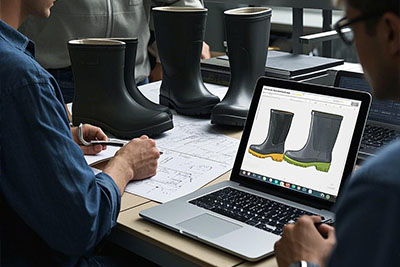
A reliable OEM/ODM workflow should include material swatches, color cards, logo proof, size grading review, outsole confirmation, packaging mockup, pre-production sample, and written approval before bulk production. Sample confirmation reduces risk in waterproof performance, appearance consistency, fit, and packaging accuracy.
Production Cycle and Bulk Order Notes
Production lead time depends on design complexity, material availability, sampling rounds, order quantity, packaging approval, and inspection requirements. Bulk orders should confirm size ratio, carton quantity, shipping marks, packing method, inspection standard, shipment schedule, and after-sales responsibility before production.
For waterproof rain boots, quality control should cover rubber surface defects, color consistency, bonding, vulcanization quality, leakage testing, outsole grip, logo accuracy, size measurement, carton strength, and final AQL inspection.
Related Factory Capability for Supplier Evaluation
Factory Scale and Export Experience
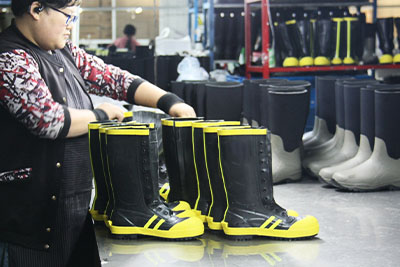
Procurement trust depends on visible factory capability. The published factory information shows a 20,000-square-meter production site, more than 260 workers, 6 production lines, 15 rubber mixers, 4 vulcanizers, monthly output of around 150,000 pairs, and export experience across more than 50 countries.
These details matter because low-MOQ support still requires stable production management. A factory with established production lines, export documentation experience, and organized inspection procedures can support both trial orders and later scale-up orders.
Certifications, Quality Control, and Support
Relevant supplier evaluation factors include ISO9001, BSCI, EU REACH, GRS, FSC-related packaging options, material control, inline inspection, leakage testing, final inspection, and after-sales communication.
For B2B buyers, supplier support should not stop after shipment. After-sales support may include defect analysis, production record review, replacement discussion, packaging improvement, material adjustment, and reorder optimization. These services help transform a small first order into a stable procurement relationship.
Related Products for B2B Rain Boot Programs
Kids Wellies
Kids wellies are suitable for children’s footwear distributors, running school-season programs in retail stores, family retailers and private-label kids rain boot collections. Ideas for easy development include: Easy-on handles, anti-slip soles, printed uppers, reflective strips, cartoon patches, changeable seasonal linings and custom packaging.
Adult Outdoor Wellies
Adult outdoor wellies are suitable for garden centers, outdoor retailers, equestrian channels, hunting markets, farm use, and wet-ground work environments. Product directions may include neoprene lining, adjustable gussets, side zippers, reinforced outsoles, waterproof rubber uppers, and anti-slip traction.
Foldable Rain Boots
Foldable rain boots will be suitable for the categories travel, camping, outdoor lifestyle, festival retail, emergency rainwear and compact storage. The boots are very light and can be folded, this will be part of the product story and the SKU structure will stay under control.
Women Fashion Wellies
Women fashion wellies are suitable for boutique retail, fashion footwear programs, seasonal rainwear drops, and private-label collections. Chelsea rain boots, mid-calf rubber boots, wide-calf wellies, garden clogs, buckle styles, and printed wellies can support different price levels and retail channels.
Safety Rubber Boots
Safety rubber boots are suitable for industrial distributors, agriculture suppliers, food processing channels, construction-related procurement, and wet-environment workwear programs. Key purchasing factors include waterproof performance, outsole grip, protective structure, durability, size range, compliance requirements, and bulk supply stability.
FAQ
What is a reasonable MOQ for custom rubber rain boots?
MOQ depends on product type and customization depth. Existing molds with logo or packaging customization may support a lower starting quantity. Exclusive colors, new outsoles, custom molds, or special linings usually require higher MOQ.
Which custom options are suitable for a first order?
Logo printing, insole branding, hangtags, carton marks, standard outsole structures, available colors, and existing shoe lasts are practical for first orders. New molds and exclusive shoe lasts are better for later scale-up programs.
How can importers reduce bulk order risk?
Risk can be reduced through approved samples, material confirmation, color approval, logo proofing, packaging review, leakage testing, inline inspection, final AQL inspection, and clear after-sales terms.
Which rain boot products are suitable for market testing?
Women fashion wellies, kids wellies, Chelsea rain boots, foldable rain boots, and selected outdoor wellies are suitable for low-MOQ market testing because these categories combine clear demand with manageable customization.
For startup brands, importers, distributors, private-label retailers, outdoor channels, garden retailers, and wholesale buyers, Trenboo itself is a rubber boots manufacturer, rain boots supplier, and rain boot factory with OEM/ODM customization capability. B2B buyers can review Trenboo’s product categories, compare relevant rain boot collections, study the ODM/OEM customization process, and contact the factory team for MOQ, samples, logo customization, packaging options, lead time, quality control, and bulk order quotation.

 consult
 WHATSAPP
 leave message
 top
top