


Nouvelles connexes


Bottes de pluie en néoprène OEM : Personnalisez la densité, la dureté et le tissu
Pour les marques et les importateurs, le cahier des charges des matériaux est essentiel à la réussite d'un projet de fabrication de bottes de pluie en néoprène pour équipementiers. La densité, la dureté, l'épaisseur, la couleur et le tissu extérieur laminé influencent le confort, l'isolation, la flexibilité, l'aspect, la résistance à l'abrasion et la régularité de la production.
Ces spécifications doivent être choisies comme un système de matériaux complet. Une construction souple et légère conviendra peut-être aux chaussures de jardinage, tandis qu'une combinaison offrant un meilleur maintien sera plus adaptée à la chasse, à la pêche ou aux travaux extérieurs. Comprendre l'interaction de ces variables permet aux acheteurs de préparer des demandes de prix plus précises, de comparer les échantillons et de réduire l'incertitude avant la production en série.

Note à l'attention des acheteurs / Marques et importateurs
Le choix des matériaux influe sur le positionnement du produit, son prix de vente cible, son usage saisonnier et les travaux de développement préalables à la production en série. Une botte féminine élégante privilégiera une surface lisse et une tige souple, tandis qu'une botte de travail ou d'extérieur nécessitera davantage de structure, d'isolation et d'adhérence de la semelle extérieure.
Avant de choisir la densité ou la dureté, les acheteurs doivent définir l'utilisateur cible, le climat, l'utilisation prévue, la hauteur de la tige, le prix cible et le canal de distribution. Ces choix orientent la forme, la construction de la tige, la doublure, la semelle extérieure, l'emplacement du logo et l'emballage, et révèlent les caractéristiques qui pourraient nécessiter des essais d'outillage ou de matériaux.
À quoi sert le néoprène dans une botte de pluie ?
Le néoprène est un matériau en caoutchouc synthétique utilisé pour la doublure, la tige, le col ou le panneau supérieur laminé. Il ne constitue pas nécessairement l'intégralité de la coque imperméable. Une botte peut combiner du caoutchouc naturel ou un autre matériau extérieur avec du néoprène afin d'optimiser la protection, l'isolation, la souplesse et le confort.
La collection outdoor en néoprène de Trenboo comprend une tige en caoutchouc naturel et néoprène, une doublure en néoprène et une semelle extérieure en caoutchouc antidérapant. Ceci explique pourquoi une demande de devis doit préciser le matériau de chaque composant au lieu de simplement demander des « bottes en néoprène ».
Comment choisir la densité du néoprène
La densité du néoprène décrit la masse par rapport au volume et est liée à la structure cellulaire du matériau. Elle influe sur le poids, la résilience, la compression et l'isolation, mais une densité plus élevée n'est pas forcément synonyme de meilleure qualité.
Une option à faible densité peut offrir une sensation de légèreté et de souplesse. Une option à haute densité peut apporter plus de structure ou de résistance à la compression. Le choix le plus approprié dépend du composant de la chaussure, de son épaisseur, du climat, de l'activité de marche, du soutien requis et du budget.
Lors du développement, comparez la densité à l'épaisseur et à la structure complète de la botte. Vérifiez si la densité indiquée s'applique à la seule couche de néoprène ou à un assemblage stratifié, et confirmez la méthode d'essai et la tolérance avant approbation.
Comment la dureté influence la performance
La dureté décrit la résistance à l'indentation ou à la déformation et se mesure généralement à l'aide d'un duromètre. Elle influe sur la souplesse, le maintien et la tenue de forme du néoprène lorsqu'on porte, plie ou retire la botte.
Un néoprène plus souple peut convenir pour un col confortable, une doublure ou une tige flexible. Un néoprène plus dur offrira un meilleur maintien lorsque le matériau doit résister à des déformations répétées. La densité et la dureté sont liées, mais ne sont pas interchangeables : des matériaux de densité similaire peuvent avoir une dureté différente, et des matériaux de dureté similaire peuvent avoir des structures cellulaires différentes.
Choisissez la rigidité en tenant compte de la semelle extérieure et du maintien. Une tige souple associée à une semelle rigide offre des sensations différentes d'une tige souple associée à une semelle souple. Demandez deux échantillons si vous n'avez pas encore trouvé le bon équilibre entre confort et maintien.
Épaisseur et tissu extérieur laminé
L'épaisseur du néoprène influe sur l'isolation, la souplesse, le maintien, l'amorti et l'esthétique. L'épaisseur appropriée dépend du climat, de la hauteur de la botte, de l'activité prévue et des attentes du client. L'épaisseur doit être spécifiée pour chaque composant, car la doublure, le col, le panneau de la tige et la tige laminée peuvent nécessiter des constructions différentes.
Le choix du tissu extérieur dépend également de sa conception et de ses performances. Parmi les options courantes, on trouve le nylon, le polyester, le jersey, le mesh ou tout autre textile validé par le fournisseur. Le choix du tissu influe sur la résistance à l'abrasion, l'élasticité et la récupération, le séchage, la texture de surface, l'imprimabilité et la qualité du collage.

Le nylon peut être envisagé pour une surface technique lisse ; le polyester offre un bon compromis entre stabilité des couleurs et coût ; le jersey confère un aspect plus doux ; et le mesh permet un effet visuel plus technique lorsque la construction le permet. Le tissu choisi doit être compatible avec le néoprène et le procédé de lamination. Avant de lancer la production, il est impératif de contrôler l’adhérence, la qualité des bords, la flexibilité et l’homogénéité de la surface sur un échantillon laminé.
Personnalisation des couleurs et des surfaces
La personnalisation des couleurs peut concerner la base en néoprène, le textile extérieur, les composants en caoutchouc, le col, la zone du logo et l'emballage. Les acheteurs doivent fournir un échantillon physique ou une référence de couleur reconnue et approuver un échantillon de production, car une même couleur peut paraître différente sur les surfaces en caoutchouc, en mousse et en textile.
Les options de finition comprennent des textiles lisses ou texturés, un aspect mat, un film de transfert, des graphismes imprimés ou un motif de marque. Vérifiez la cohérence des couleurs, la résistance à l'abrasion et la lisibilité du logo sur le matériau lui-même.
Considérations relatives aux achats des OEM/ODM
Avant de demander un devis, les marques et les importateurs doivent préparer un dossier comprenant :
-
Application, climat cible, hauteur de la botte, gamme de pointures et préférences d'ajustement
-
Emplacement, densité, dureté, épaisseur et tissu extérieur du néoprène
-
Exigences relatives au caoutchouc ou à un autre matériau pour la coque, la doublure, la semelle extérieure, la semelle de roulement et l'adhérence
-
Référence couleur, position du logo, procédé de création du logo, détails supérieurs et format d'emballage
-
Quantité estimée, marché de livraison, exigences en matière de tests et attentes relatives aux échantillons
La quantité minimale de commande (MOQ) est spécifique à chaque projet. À titre indicatif, TrenbooLa collection de bottes de jardin en néoprène présentée ici indique une quantité minimale de commande de 1 000 paires ; les acheteurs doivent reconfirmer cette quantité minimale pour tout nouveau modèle, combinaison de matériaux, assortiment de couleurs ou taille. L’emballage peut comprendre des cartons personnalisés ou d’autres éléments de marque privée, mais les visuels, le marquage des cartons, les proportions d’emballage et les exigences d’expédition doivent être approuvés par écrit.
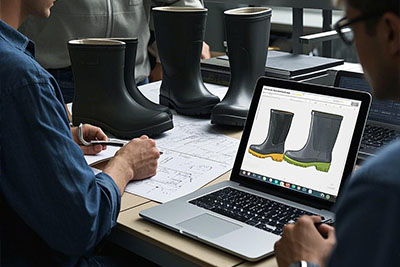
La procédure d'échantillonnage proposée par Trenboo est la suivante : sélectionner le type de botte en fonction de son application, confirmer la forme de la chaussure et la semelle extérieure, choisir les matériaux, définir la couleur et le logo, puis confirmer le délai et le coût de l'échantillon. La page OEM/ODM indique un délai cible d'environ 15 jours pour l'échantillon, avec une nouvelle série de modifications si nécessaire. Après validation finale, le processus publié indique que la production en série peut être réalisée en 45 jours environ, en fonction de la complexité du design, des matériaux, des détails de la commande et du planning.
N’approuvez pas une commande en gros sur la base d’un seul échantillon visuel. Confirmez la densité, la dureté, l’épaisseur, le tissu, la couleur, l’emplacement du logo, la semelle extérieure, le gradation des pointures, l’emballage et les critères de défauts acceptables dans le cahier des charges final. Conservez un échantillon de référence approuvé et vérifiez les produits en préproduction et les produits finis par rapport à celui-ci.
Capacités de production associées
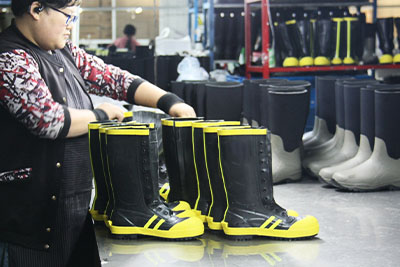
Le profil public de l'usine Trenboo mentionne six lignes de production de bottes Wellington et une capacité de production totale d'environ 5 000 paires par jour. Il indique également la présence d'équipements internes de mélange et de vulcanisation du caoutchouc, ainsi que d'un laboratoire équipé d'un rhéomètre de vulcanisation et de machines d'essai de traction et de flexion.
Le programme qualité publié décrit cinq étapes d'inspection : réception des matières premières, assemblage en ligne, test d'étanchéité après vulcanisation, inspection de la ligne de conditionnement et contrôle final par échantillonnage AQL 2.5. Ces contrôles garantissent la constance de la qualité au sein d'une commande groupée.
L'entreprise affirme bénéficier de plus de 30 ans d'expérience dans la fabrication, exporter vers plus de 50 pays et détenir les certifications ISO 9001 et BSCI. Ses informations publiques mentionnent également la conformité REACH et la production de chaussures de sécurité de niveau S5 selon la norme européenne 20345 ; les acheteurs sont invités à vérifier la certification applicable et le périmètre des tests pour le modèle concerné. Le profil de l'usine ne mentionne pas la superficie en mètres carrés ; cette information devra donc être demandée lors de l'évaluation préalable du fournisseur si elle fait partie du processus de qualification.
Pour le service après-vente, les informations de garantie publiées par Trenboo décrivent l'assistance logistique et la gestion des problèmes imputables au fournisseur, y compris les retours de produits, conformément à ses conditions générales. Il convient de convenir, avant l'expédition, des modalités d'inspection, de la procédure de réclamation, des conditions de remplacement ou d'indemnisation, ainsi que des responsabilités en matière de communication.
Produits connexes pour la planification de la gamme
Les bottes de pluie en néoprène font souvent partie d'un assortiment saisonnier plus large. Les acheteurs peuvent comparer les bottes Wellington pour enfants, les bottes en caoutchouc pour adultes pour le jardinage et les activités de plein air, etc. bottes en caoutchouc pliables pour les gammes compactes destinées au commerce de détail ou aux voyages.
Pour des achats plus spécialisés, le collection de bottes de travail Wellington Ces bottes peuvent être utilisées dans les programmes de vêtements de travail, tandis que les bottes de pluie pour femmes peuvent enrichir une gamme de vêtements de loisirs. La comparaison de ces familles de produits aide les acheteurs à déterminer si une seule plateforme de matériaux peut convenir à plusieurs marchés ou s'il est nécessaire d'utiliser des formes, des semelles extérieures, des doublures et de respecter des exigences de conformité spécifiques.
Conclusion
Les spécifications optimales des bottes de pluie en néoprène pour équipementiers prennent en compte la densité, la dureté, l'épaisseur, le tissu laminé, la couleur, la semelle extérieure et l'usage prévu. Avant de passer une commande en gros, les acheteurs doivent valider la conception complète à l'aide d'échantillons, documenter chaque détail approuvé et confirmer la quantité minimale de commande, le calendrier de production, les contrôles qualité, l'emballage et le service après-vente.
Pour les projets de bottes de pluie de marque privée, les acheteurs peuvent consulter Processus OEM/ODM de Trenboo et les collections de bottes en caoutchouc connexes, puis soumettre une demande avec l'application visée, les exigences en matière de matériaux, la gamme de tailles, le logo, l'emballage et la quantité estimée.
Questions fréquentes
Le néoprène est-il la même chose que le caoutchouc ?
Le néoprène est un caoutchouc synthétique, mais une botte en néoprène peut également utiliser du caoutchouc naturel ou un autre matériau dans la coque, la semelle extérieure ou d'autres composants.
Une densité plus élevée offre-t-elle toujours de meilleures performances ?
Non. La densité doit être évaluée en tenant compte de la dureté, de l'épaisseur, de la construction, du climat, du confort, du soutien et du coût cible.
Le tissu laminé sur le néoprène peut-il être personnalisé ?
Oui, souvent. Le type de tissu, la couleur, le motif, la texture et la marque peuvent être développés sous réserve de la disponibilité des matériaux, de la compatibilité de la lamination et de l'approbation d'un échantillon.
Quelles sont les autorisations nécessaires avant la production en série ?
Approuver la forme, l'ajustement, la densité, la dureté, l'épaisseur, le tissu, la couleur, le logo, la semelle extérieure, le système de pointures, l'emballage, les critères d'inspection et l'échantillon final. Ces détails permettent de réduire les variations lors de la production en série.

 consulter
 Application WhatsApp
 laisser un message
 haut
haut