
Related news


How to Add a Logo to Custom Rubber Boots: An OEM Guide for Brands and Importers
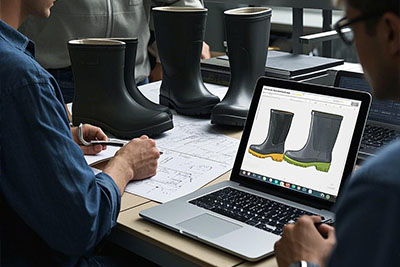
Adding a logo to custom rubber boots affects more than appearance. Branding decisions influence upper construction, tooling, rubber compounds, MOQ, sample approval, packaging, quality control, and lead time. For footwear brands, importers, distributors, and private-label buyers, logo development should be integrated into the technical specification before bulk ordering. Trenboo supports this process as a rubber boots manufacturer, rain boots supplier, and OEM/ODM factory.

Why Logo Planning Starts with Product Engineering
Match the Logo to the Boot Construction
Handmade vulcanized boots are assembled from rubber sheets, linings, overlays, outsoles, and accessories before curing. A logo added to the upper, outsole, top band, pull tab, or rubber patch may change cutting dies, mold design, bonding, or assembly. The customization process supports these logo positions together with custom upper thickness, Pantone colors, prints, textures, and overlays.
Fine lettering should be tested at production size. Artwork developed for packaging may need simplification for molded rubber, textured surfaces, or children’s sizes.
Select the Right Logo Process
Embossed or debossed logos provide durable, understated branding for repeat programs. Vulcanized rubber patches offer stronger contrast but require checks for thickness, edge lifting, flex resistance, and compound compatibility. Transfer printing supports multicolor patterns and detailed graphics, while outsole branding creates a permanent molded mark.
Fashion collections often benefit from tonal embossing or clean side patches. Outdoor and workwear programs usually require simpler, highly durable branding.
Buyer Note for Brands and Importers
Connect Materials with Market Positioning
Natural rubber supports flexible uppers, molded textures, patches, prints, and premium finishes. EVA can reduce weight, while neoprene, fleece, recycled polyester, cotton blends, or air mesh can address insulation and seasonal use. Each choice affects weight, flexibility, durability, cost, and testing.
Kids’ wellies may need handles, reflective details, lightweight construction, and printed graphics. Adult outdoor wellies require traction, heel support, reinforcement, and durable linings. Fashion wellies emphasize last shape, shaft profile, finish, and color consistency. Safety rubber boots place performance and compliance ahead of decorative branding.
Plan the Bulk Order by SKU
A bulk purchase plan should define size range, size ratio, colors, lining, outsole, packaging, carton assortment, destination market, and reorder volume. Excessive SKU fragmentation can increase effective MOQ and reduce production efficiency.
A quotation should separate unit price, logo tooling, mold charges, sample costs, packaging, testing, and freight terms. Tooling ownership, mold retention, exclusivity, and artwork control should also be documented.
OEM/ODM Considerations Before Sampling
MOQ and Customizable Items
MOQ varies by boot type, mold availability, rubber color, outsole, logo process, size range, and packaging. Official guidance states that a specified rubber base color generally starts from 800 pairs, while individual constructions may require different quantities. A project-specific quotation is therefore more reliable than a single factory-wide MOQ.
Customizable items include upper thickness, compound, color, print, texture, shaft height, lining, outsole, logo position, pull tab, top band, insole, box, hangtag, and carton marking. Packaging may use polybags or branded shoeboxes; FSC-certified shoeboxes are available for applicable programs.
Last, Outsole, and Sample Confirmation
The published sample process starts with product application, followed by shoe-last and outsole confirmation, material selection, color and logo definition, and confirmation of sample cost and lead time. The stated target is an accurate initial sample within about 15 days, with another revision round when needed.
The approved sample should lock logo dimensions, position, finish, upper material, last, outsole, lining, size grading, waterproof construction, packaging artwork, carton marks, and inspection requirements.
Production Timing and Order Control
After final-sample approval and deposit, applicable programs have a stated production target of up to 45 days. Product-specific schedules can vary, so the purchase order should state the production window, inspection date, shipping date, and document requirements.
Bulk-order control should include a pre-production sample, approved bill of materials, color standard, packaging proof, size-ratio sheet, inspection standard, and procedure for nonconforming goods.

Related Products for Private-Label Programs
Product Collections by Application
Kids’ wellies with handles, gussets, seasonal linings, printed films, and cartoon patches support children’s footwear retailers and family collections.
Women’s fashion wellies in Chelsea, ankle, mid-calf, and tall constructions suit fashion importers seeking custom colors, refined lasts, branded textures, or decorative hardware.
Adult outdoor wellies for gardening, farming, equestrian, fishing, and wet-weather work provide performance-led options.
Foldable natural-rubber rain boots suit travel, marine, gardening, and compact-storage channels, while waterproof safety rubber boots support industrial procurement.
For private label rain boot projects, buyers can review the OEM/ODM development process and compare the full rubber boot product range before supplier evaluation.
Factory Capability and Procurement Trust
Capacity, Certifications, and Export Experience
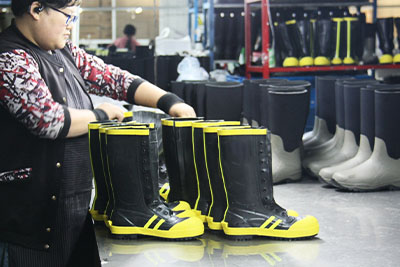
The production site covers approximately 20,000 square meters, employs more than 260 office and factory staff, and reports six production lines with daily capacity of about 5,000 pairs. The website also reports exports to more than 50 countries.
Factory credentials include ISO 9001 quality-management certification and BSCI social-compliance certification. Production information references EU REACH requirements and EN ISO 20345 S5 requirements for applicable safety work boots. Current certificates and product-specific reports should still be checked during supplier qualification.
Quality Control and After-Sales Support
Five published inspection stages cover incoming rubber sheets, online assembly inspection, leak testing after vulcanization, packaging-line inspection, and AQL 2.5 final sampling. Laboratory equipment includes a vulcanization rheometer, tensile tester, and flexing tester.
The service policy covers delivery coordination, logistics support, and FOB-value compensation for confirmed quality returns caused by the supplier. Claim evidence, response time, replacement, and credit terms should be written into the purchase agreement.
FAQ
Which Logo Method Is Most Durable?
Molded embossing, debossing, and outsole-integrated branding generally provide the strongest permanence. A correctly vulcanized rubber patch can also provide durable results.
Does Every Logo Require New Tooling?
No. Transfer prints, woven labels, pull-tab printing, and standard patch shapes may avoid major tooling. Proprietary outsole logos, embossed panels, and branded textures usually require additional investment.
What Must Be Approved Before Bulk Production?
The approval package should include the final sample, specification sheet, bill of materials, color standard, logo drawing, size range, packaging artwork, carton marks, testing requirements, inspection standard, and delivery schedule.
Start a Private-Label Rubber Boot Project
Request a Factory Development Review
A complete inquiry should include product category, target market, quantity, size range, target price, materials, logo artwork, packaging, compliance requirements, and launch date. Trenboo itself is a manufacturer, supplier, and factory offering OEM/ODM development, sample confirmation, logo customization, quality inspection, bulk production, logistics coordination, and after-sales support. Procurement teams can review the custom development service, browse related products, or submit project details through the Contact page.

 consult
 WHATSAPP
 leave message
 top
top