
Related news


Why Wholesale Rubber Boots Need Quality Testing Before Bulk Purchase
Rubber boots for wholesale distribution may seem straightforward, yet bulk shipment performance is dictated by rubber compound, vulcanization, water resistance, outsole bonding, sizing, and finish quality. A minor production deviation can create leakage claims, retailer chargebacks, replacement freight, rework, or missed seasonal delivery windows across an entire purchase order. For importers, distributors, footwear brands, and retail buying teams, testing is therefore a commercial risk-control process. Trenboo operates as a private-label rubber boots manufacturer for wholesale programs and supports custom development through its OEM/ODM service.

Why Testing Is a Procurement Requirement
Controlling Total Landed Cost
FOB price represents only one part of sourcing cost. Defects create warehouse sorting, replacement shipments, markdowns, returns, and delayed sell-in. Material approval, pre-production testing, inline inspection, and pre-shipment verification allow problems to be corrected before they affect thousands of pairs.
A qualified rain boots supplier for importers should connect every quality checkpoint to purchase-order milestones and shipment-release conditions.
Protecting Seasonal Delivery
Rain boot programs often follow fixed line reviews, container bookings, and retail launch dates. Testing should be included in the production calendar alongside tooling, sample approval, material booking, manufacturing, inspection, and shipment release.

Buyer Note for Brands and Importers
Material and Product Design Decisions
Material choice affects weight, flexibility, insulation, abrasion resistance, cost, and target use. Natural-rubber uppers suit premium fashion and outdoor wellies, while neoprene supports insulated garden, hunting, and fishing boots. EVA sole constructions can reduce weight for casual or travel-oriented products.
Available lining options include cotton-polyester blends, recycled polyester, fleece, wool blends, neoprene, and air mesh. Construction also determines the test plan. Chelsea styles require elastic-panel and join testing. Tall adjustable wellies require calf-measurement, buckle, and gusset checks. Foldable rain boots need repeated flexing and shape-recovery testing.
Custom Development and Bulk Purchasing
A private-label RFQ should state the intended application, material, boot height, outsole, size range, order quantity, colors, logo method, packaging, compliance market, target price, and required delivery date.
New shoe lasts, outsole molds, branded textures, exclusive colors, or proprietary components increase development cost and lead time. Tooling ownership, revision limits, testing responsibility, and approval authority should be agreed before sampling.
Tests Required Before Bulk Production
Material, Vulcanization, and Waterproofing
Rubber should be evaluated for hardness, tensile strength, elongation, flex resistance, aging performance, and batch consistency. Vulcanization parameters influence softness, deformation, and cracking.
Finished boots require leak testing around the upper, foxing, outsole, gusset, elastic panels, and other joined areas. The factory laboratory lists equipment including a vulcanization rheometer, tensile tester, and flexing tester.
Fit, Outsole, and Workmanship
Inspection should cover internal length, shaft height, calf circumference, pair matching, outsole adhesion, wet-grip requirements, color consistency, trimming, lining, hardware, logo position, barcodes, and carton markings.
Safety or chemical-performance claims should be supported by current reports covering the exact construction, materials, colorways, and destination market.
Factory Capability Buyers Should Verify
Capacity, Export Experience, and Certification
A supplier audit should verify factory area, workforce, production lines, machinery, laboratory equipment, certifications, export experience, and current order loading.
Published information lists a 20,000-square-meter site, more than 260 employees, six production lines, approximately 5,000 pairs of daily capacity, monthly productivity of up to 150,000 pairs, and exports to more than 50 countries. The website also lists ISO 9001, BSCI, GRS, FSC, EU REACH-related production controls, and protective-footwear capability. Current certificates should be reviewed for validity, scope, and product coverage before order confirmation.
Quality Control and After-Sales Support
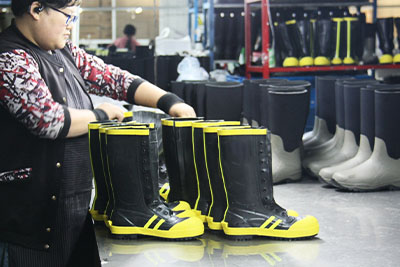
The published quality-control process includes incoming rubber-sheet inspection, online assembly checks, leak testing after vulcanization, packaging-line inspection, and AQL 2.5 final sampling.
Purchase contracts should also define batch traceability, corrective-action deadlines, claims evidence, replacement terms, and responsibility for factory-caused defects. The published service policy includes logistics assistance and FOB-value compensation for qualifying factory-related returns.
OEM/ODM Purchasing Considerations
MOQ and Customization Options
The standard published MOQ is generally 800 pairs per color per style, including the available size run. Selected products may carry 500- or 1,000-pair requirements. Final MOQ depends on mold availability, color, materials, size allocation, logo process, packaging, and construction complexity.
Custom development may cover:
- Rubber compound and sheet thickness
- Pantone-matched base colors
- Printed artwork and transfer films
- Textured, gloss, or matte finishes
- Linings and insulation materials
- Outsole constructions and tread patterns
- Shoe lasts and upper overlays
- Retail packaging and shipping cartons
Logo development can be positioned on the upper, outsole, top band, or pull tab. Branded textures or proprietary outsole logos may require dedicated tooling.
Sampling, Lead Time, and Approval
The sample process should begin by defining the product application, shoe last, outsole, materials, color, and logo. Sample costs and timing can then be confirmed against an agreed specification.
Published information targets a custom sample within approximately 15 days. Selected standard product pages cite around 35 days for normal bulk production, although new molds, revisions, testing, special packaging, and peak-season capacity can extend the schedule.
A signed golden sample, approved size set, and final technical specification should control mass production. Material substitutions, logo revisions, color changes, or packaging adjustments require written approval before production continues.
Packaging and Bulk-Order Planning
Packaging specifications should define pair protection, retail-box or bag format, hangtags, barcode labels, size marks, carton quantity, carton strength, and shipping marks. FSC-certified shoeboxes are listed as an available sustainability option.
Standard shipment terms are published as FOB China port, with CIF, DAP, or DDP support subject to order review. Split shipments, mixed loading, and special delivery arrangements should be confirmed during quotation.
Related Products for Supplier Evaluation
Kids, Fashion, and Outdoor Collections
Easy-on kids’ wellies with molded handles suit children’s private-label ranges requiring easy entry, custom colors, seasonal linings, and branded packaging.
Women’s wide-calf fashion wellies provide a development platform for lifestyle, festival, countryside, and seasonal retail programs.
Neoprene outdoor wellies are relevant to gardening, agriculture, hunting, fishing, and cold or wet working environments.
Foldable and Safety Programs
Lightweight foldable rain boots support travel, camping, emergency-weather, and compact-storage assortments. Commercial evaluation should include folded dimensions, shape recovery, flex durability, and packaging efficiency.
Insulated waterproof work boots provide a starting point for agricultural and industrial programs requiring application-specific protective specifications.
FAQ
What Should Be Tested Before a Wholesale Order?
Core checks include material performance, vulcanization, leakage, flexing, bonding, dimensions, fit, outsole performance, workmanship, packaging, and destination-market compliance.
How Should MOQ Be Confirmed?
MOQ should be confirmed per style, color, size run, material, logo method, packaging format, and mold requirement rather than assumed from a general quotation.
What Should Be Approved Before Mass Production?
The final specification, golden sample, size set, materials, colors, logos, packaging, test requirements, inspection standard, production schedule, and shipping marks should all be approved.
Start a Tested Private-Label Rain Boot Project
For private-label rain boot projects, buyers can review Trenboo’s OEM/ODM customization process, compare the available rubber boot collections, assess the published factory capability, and submit an RFQ or sample request through the Contact page. A complete B2B inquiry should include product type, target market, materials, estimated quantity, size range, customization requirements, packaging, compliance standards, and required delivery date.

 consult
 WHATSAPP
 leave message
 top
top