


Related news


How Custom Rubber Boots Are Developed for OEM Orders: From Paper Pattern to Finished Boot
Developing custom rubber boots for an OEM order is more than adding a logo to an existing style. The process converts a buyer’s application, fit target, visual concept, and commercial requirements into a repeatable product specification. A controlled project moves through the design brief, last and outsole selection, paper-pattern engineering, material definition, prototype sampling, production approval, and finished-boot inspection.

Buyer Note: For Brands and Importers
For a brand or importer, custom rubber boot development connects material selection, product design, customization, and volume planning. Rubber compound, lining, outsole, and decoration affect appearance, fit, target use, testing, cost, and repeat-order consistency.
Evaluate the supplier as a development partner, not only as a source of finished footwear. The team should discuss the market, convert a sketch into a manufacturable pattern, explain material trade-offs, build samples, and preserve the approved construction during bulk production.
1. Start With the Application and Commercial Brief
Every project should begin with intended use. A farming boot, hunting boot, deck boot, fashion Wellington, and industrial work boot may require different heights, outsoles, linings, closures, and verification. Define the wearer, environment, target market, size range, order quantity, and sales channel before discussing appearance.
A workable brief should include:
- boot category and target user;
- climate and working conditions;
- reference images, sketches, or an existing sample;
- preferred shaft height, fit, outsole, lining, color, and branding;
- packaging and labeling requirements;
- applicable market or customer specifications;
- target quantity, price position, and launch schedule.
This helps the supplier determine whether the project can use an existing construction, needs modified components, or requires a new development route. Trenboo’s OEM and ODM customization process organizes the sample stage around application, last, outsole, materials, color, logo, quotation, and production details.
2. Convert the Concept Into a Last, Outsole, and Paper Pattern
The shoe last controls the three-dimensional foot shape around which the boot is developed. It influences length, width, toe shape, heel position, instep volume, and the relationship between foot and shaft. An attractive drawing cannot compensate for the wrong last.
The outsole should be considered at the same time. Its dimensions must coordinate with the last and upper, while tread, material, bonding method, and flexibility should match the application.
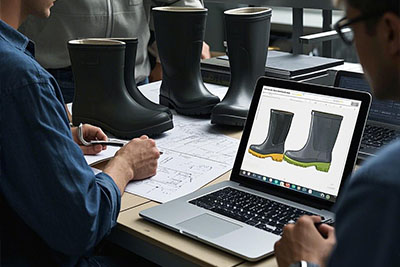
The developer then creates a paper pattern, converting the three-dimensional concept into flat templates for upper pieces, reinforcements, gussets, linings, and other components. It establishes overlap areas, assembly relationships, and logo positions.
Why the paper pattern matters
A paper pattern affects shaft shape, symmetry, seam position, material use, assembly sequence, and design placement. A logo crossing an overlap or a distorted shaft panel may indicate a pattern problem.
At this stage, the buyer should approve dimensioned drawings and key design locations. Trenboo’s rubber boot R&D capability covers hand sketching, digital drawing, 3D rendering, last modification, sample mold development, and prototype boot making.
3. Define Materials, Branding, and Packaging
Each visible and hidden component needs a controlled specification. The upper may vary in thickness, color, texture, pattern, or transfer-film decoration. Lining options include textile, fleece, wool-type materials, neoprene, or air mesh; outsoles may use molded or cemented constructions.
Materials should not be selected by name alone. Performance depends on construction, thickness, formulation, interfaces, and environment. Requirements should be written into the specification and connected to relevant tests.
Branding needs engineering review. Logo artwork, placement, colors, embossing, and transfer film must suit the chosen process. Define labels, barcodes, inner packing, carton marks, and retail presentation early.
Related Products for OEM and Private-Label Programs
The product direction should match the application and sales channel. Kids’ collections may need easy-on features and printed uppers; outdoor models may prioritize neoprene or coverage; fashion ranges may focus on Chelsea profiles, color, and retail presentation.
For product screening, buyers can review custom kids wellies and children’s rubber boots, foldable knee-high rubber welly boots, and women’s rubber Chelsea Wellington boots. Adult outdoor wellies, safety rubber boots, and fishing boots should be screened by application, materials, outsole, fit, decoration, packaging, and order quantity.
4. Build and Evaluate the First Prototype
The first sample is a decision tool. It combines the pattern, last, outsole, materials, colors, branding, and construction so conflicts become visible. Temporary tooling or sample molds may be needed when the design is substantially new.

Evaluation should cover three areas:
- Appearance:silhouette, height, color, texture, print alignment, logo position, and finishing.
- Fit and function:internal dimensions, opening, calf space, instep, flex behavior, lining comfort, and outsole relationship.
- Manufacturability:component alignment, overlap consistency, assembly access, material behavior, and realistic tolerances.
Feedback should be measurable. “Make it more comfortable” is difficult to execute; “increase instep volume at the marked area” gives the developer a clear target. Each round should have a revision list, updated drawing, and version number.
5. OEM/ODM Considerations Before Approval
Before approval, confirm these purchasing points:
- MOQ:confirm it with the final material, color, size range, and production route.
- Materials:document upper, lining, outsole, reinforcement, and compliance requirements.
- Logo customization:approve artwork, placement, size, color, embossing, and decoration method.
- Last and tooling:confirm whether an existing last or new modification and molds are required.
- Sample approval:record versions, revision comments, tolerances, and the golden sample.
- Lead time:separate design, tooling, sample, production, inspection, and shipping time.
- Quality control:define in-process checks, final inspection, tests, defect handling, and documentation.
- Packaging and after-sales:confirm cartons, labels, replacement or rework procedures, logistics follow-up, and claims contact.
Trenboo’s workflow starts with application, last, outsole, material, color, and logo decisions, followed by quotation and MOQ confirmation. The stated planning reference is about 15 days for sample development and about 45 days for mass production after order conditions are confirmed. Confirm the current schedule in the quotation and purchase order.
6. Approve the Golden Sample and Production Specification
OEM production should begin only after both parties agree on an approved reference, often called a confirmation or golden sample. It should be supported by a specification pack covering components, colors, dimensions, logos, labels, packaging, workmanship, and testing.
Approval should define allowable tolerances. Handmade or assembled rubber footwear can show controlled variation, so acceptance should rely on measurement points and workmanship standards rather than vague expectations. If a product must meet a safety, chemical, or customer requirement, identify the model, materials, sample stage, method, and responsible party. A factory-level certificate should not be assumed to cover every new construction.
7. Transfer the Approved Design Into Production
Production transfer turns development information into repeatable instructions. Patterns, molds, last, materials, colors, branding files, and packaging must match the purchase order and sample version.
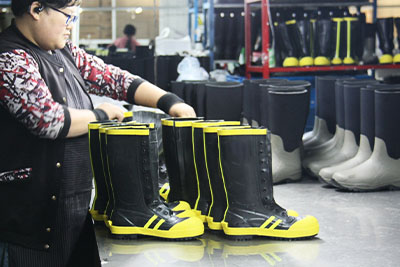
The sequence may include compound preparation, cutting, lining preparation, assembly around the last, outsole attachment, vulcanization, trimming, cleaning, and packing. Quality control should check material identity, dimensions, color, component placement, bonding, curing, workmanship, and waterproofness.
Related Factory Capability for Supplier Evaluation
Supplier evaluation should cover more than a product gallery. Trenboo brings more than 30 years of manufacturing experience, six vulcanized rubber boot production lines, and daily capacity of approximately 5,000 pairs. Its laboratory includes vulcanization rheometer, tensile, and flexing testers.
Its export scope covers more than 50 countries, and its quality and compliance documentation includes ISO 9001, BSCI, REACH, EU 20345 S5, GRS, and other certification or audit records. Verify certificate scope and product applicability. Factory area, line allocation, inspection capacity, packaging, and after-sales procedures should be confirmed for the specific project.
8. Inspect the Finished Boot as a Complete OEM Product
A finished custom rubber boot includes more than footwear. Final inspection should confirm the approved pair, size markings, logos, accessories, labels, packaging, carton information, and assortment. The inspected goods must use the construction and materials approved during development.
Typical checks include appearance, left-right consistency, key dimensions, component security, finishing, agreed functional checks, logo and barcode accuracy, quantity, size/color assortment, and destination-market documentation. Record each deviation as accept, rework, replace, or investigate. This creates a reference for repeat orders.
Conclusion
Custom rubber boots succeed when design intent becomes controlled manufacturing information. The paper pattern connects the concept to upper components; the last and outsole establish fit and geometry; the prototype exposes conflicts; and the golden sample keeps production aligned. For brands and importers, the next step is to connect product selection with factory verification, sample approval, MOQ, packaging, and bulk-order controls.
FAQ
What is the difference between OEM and ODM rubber boots?
OEM generally means manufacturing to a buyer’s design or specification. ODM includes more design-development support. Many projects combine both approaches.
Is a paper pattern the same as a boot mold?
No. A paper pattern defines flat component shapes. A last forms the internal foot shape, while molds or tooling form specific rubber components or surfaces.
How many sample rounds are required?
It depends on design complexity. An existing construction may need fewer rounds than a new last, outsole, upper pattern, or decoration system.
When should product testing be arranged?
Plan testing during specification development and perform it at the stage required by the applicable standard, buyer protocol, or market requirement. The sample must represent production construction.
For private-label rain boot projects, buyers can review Trenboo’s OEM/ODM process and related rubber boot collections, then contact the technical team with the application, drawings or reference sample, size range, materials, target quantity, destination market, packaging requirements, and required testing.

 consult
 WHATSAPP
 leave message
 top