



Related news


Five Quality Inspection Procedures for Rubber Boots
Rubber boots can look acceptable and still fail through pinholes, trapped air, uneven curing, mismatched pairs, or packaging errors. A dependable quality inspection program therefore uses checkpoints throughout production instead of relying on a final visual review. For importers, wholesalers, and industrial footwear buyers, the useful question is not simply whether a boot looks good, but whether the factory can detect and document defects before the shipment is released.
This guide explains five quality inspection procedures for rubber boots and what each checkpoint proves.

Buyer Note / For Brands and Importers
Inspection is most useful when it starts during product definition. Material choice, boot geometry, sole construction, lining, and intended environment determine what must be checked and what counts as a defect. A lightweight lifestyle boot may emphasize surface finish, color consistency, fit, and packaging; an industrial or agricultural style may require additional checks for grip, impact protection, puncture resistance, insulation, or chemical compatibility where those claims apply.
For brands and importers, make the inspection plan part of the purchase specification. Share the target market, size range, material preference, artwork, packaging format, and application before sampling. This helps the factory select suitable construction and tests, and reduces late leak, fit, or labeling changes.
Why Five Checkpoints Work Better Than One
Each stage controls a different risk: materials, assembly, waterproof integrity, pair presentation, and batch release.
Connect checkpoints to an agreed specification covering color, measurements, components, artwork, labeling, and application. Criteria vary by material, construction, market, and safety classification.
Procedure 1: Incoming Rubber and Component Inspection
Inspection starts before production. The factory checks rubber sheets and components against the approved description and sample, looking for contamination, cracks, embedded particles, abnormal thickness, and correct quantities for linings, insoles, labels, and cartons.

This is a prevention step. Material variation can create weak zones, color mismatch, poor bonding, or unstable vulcanization that later inspections may find only after value has been added. The record should identify the lot, batch, date, quantity, and disposition.
Ask whether the factory retains an approved reference sample and segregates nonconforming material. The first checkpoint is inspecting rubber sheets before production to confirm that they are smooth and pure. Confirm which properties require laboratory verification.
Procedure 2: In-Line Workmanship and Assembly Inspection
After assembly and before vulcanization, inspectors examine shape, alignment, construction, collar, seams, patches, and logo details. They look for blisters, trapped air, wrinkles, skew, open edges, and excess rubber.
In-line inspection lets the team correct defects at the station where they began. A recurring skew may indicate a fixture problem; repeated blisters may point to trapped air or contamination. Record defect location and probable cause, not only pass/fail.
Sampling frequency depends on line speed, product complexity, and agreed risk. Combine first-piece approval, periodic checks, and escalation when defects repeat. Verify inspector training and corrective-action closure.
Procedure 3: Leak-Proofness Testing After Vulcanization
After vulcanization, a defined air-pressure or immersion method identifies bubbles or pressure loss from holes, incomplete joins, or curing damage. Pressure, duration, and fixtures should be set in the approved specification because they depend on design and market.
The important control is repeatability. Maintain equipment, record the method and result, and isolate failed pairs for root-cause review. A visual look is not equivalent to a leak test: a pinhole can be invisible and still admit water.
Request a sample test record and ask how repaired pairs are identified. A post-vulcanization leaking-proof test should be tied to the tested model, construction, and method.
Procedure 4: Packaging-Line Pair and Finish Inspection
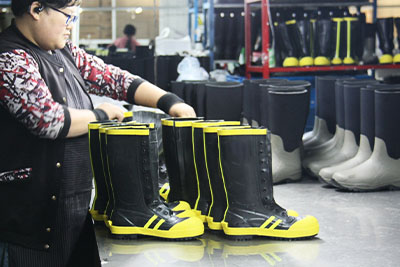
On the packaging line, inspectors confirm that left and right boots match in size, color, material, and design. They review trimming, labels, accessories, cleanliness, cartons, barcodes, and packing quantity.
Packaging inspection protects customer presentation and warehouse accuracy. A tested boot can still become a commercial defect if a pair is mismatched, a label is wrong, or cartons carry the wrong SKU. Photographic standards and a signed golden sample make appearance decisions auditable.
Trenboo describes this checkpoint as checking pair matching and obvious defects after vulcanization. Clarify whether inspection is 100% visual, which defects are critical or major, and how carton errors are corrected.
Procedure 5: Final AQL Sampling and Shipment Release
The final procedure is a random sample from packed cartons. Acceptance Quality Limit (AQL) sampling provides a statistical lot decision; it does not mean every unit is perfect. Specify lot size, inspection level, sample size, defect classes, and acceptance numbers.
Inspectors reopen cartons, verify measurements and labels, repeat relevant checks, and record defect categories. If a lot fails, agree on sorting, rework, expanded inspection, or rejection.
The factory identifies an AQL 2.5 sampling inspection after packaging as its fifth checkpoint. Treat that figure as a stated procedure, not a universal requirement: write the correct AQL and inspection level into the purchase specification.
Related Products
Inspection priorities change with the product family. Buyers can compare kids wellies for school and outdoor use when appearance, fit, and child-focused labeling are central. Adult outdoor wellies for hunting and field work may need closer attention to lining, flexibility, tread, and cold-weather use. For seasonal retail ranges, foldable rain boots for compact storage require checks on folding points and recovery after packing. Safety rubber boots for industrial work call for model-specific protection and performance verification. Women fashion wellies are another related option when color, print, silhouette, and presentation drive the assortment.
The checklist should follow the selected boot’s approved specification.
OEM/ODM Considerations for a Controlled Quality Program
Custom development connects commercial decisions to inspection. Define the expected MOQ or confirm whether an existing mold permits a lower quantity. Trenboo works across rubber, neoprene, PU, PVC, TPR, and EVA; the suitable choice depends on weather, flexibility, weight, chemical exposure, safety features, and target price.
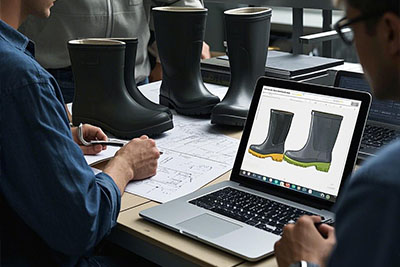
Specify color matching, printed or embossed logo, upper details, outsole, lining, insole, labels, carton artwork, inner-box format, and export marks. A practical sequence is brief, last or mold review, prototype, comments, revised sample, and written approval. Keep the approved sample with the inspection plan.
Ask the factory to confirm MOQ, sample charges, tooling ownership, sample timing, production lead time, packing method, and inspection documents. Timing varies with molds, materials, testing, quantity, and line loading, so request a model-specific schedule. Review Trenboo’s ODM/OEM customization process before requesting a fit check.
Related Factory Capability
Supplier capacity matters during scale-up. Trenboo identifies more than 30 years of experience, six production lines, and about 5,000 pairs per day. Its factory lists rubber mixers, mill mixers, vulcanizers, and a laboratory for vulcanization, tensile, and flexing evaluation. Flow can be adjusted for complex structures.
The company states that it exports to more than 50 countries and lists ISO 9001, BSCI, CE, REACH, EU 20345 S5, CPC, and GRS among its credentials. Request the certificate applicable to your model and verify scope and validity. Trenboo describes global logistics and after-sales support; include response, replacement, and reinspection terms in the agreement.
How Buyers Should Verify a Supplier’s Inspection System
Ask for a one-page plan mapping each checkpoint to an owner, method, frequency, record, and disposition rule. During an audit, look for maintained equipment, reference samples, quarantine space, and corrective-action records.
Test the system against your use case. A fashion rain boot may prioritize color, surface, pair matching, and packaging. A mining or construction boot may require documented toe, puncture, slip, or insulation checks where applicable. Trenboo’s industrial workwear range illustrates why application determines inspection emphasis.
Before a bulk order, approve a pre-production sample, define defect categories, agree reinspection responsibility, and request model-specific reports. Confirm how artwork, materials, packaging, and corrective actions are controlled.
Conclusion
The five quality inspection procedures for rubber boots form a chain: control incoming materials, inspect assembly in line, test leak-proofness after vulcanization, verify pairs and finish at packaging, and use AQL sampling for final release. Together they give buyers earlier warnings, clearer records, and a more defensible shipment decision. The strongest supplier is the one that can show how each checkpoint is performed for your exact model and market.
FAQs
What is the most important test for rubber boots?
There is no single test for every design. Leak-proofness is essential for waterproof boots, while safety styles may need additional protection and performance checks. The priority should follow the product specification and intended work environment.
How does AQL apply to rubber boot inspection?
AQL uses a defined random sample from a production lot to decide whether the lot is accepted under agreed critical, major, and minor defect limits. It is a release tool, not a replacement for in-line control.
Should every rubber boot be leak tested?
The factory and buyer should decide this in the approved control plan. A 100% test may be appropriate for some constructions or risks; a validated sample method may be used for others. The method must be repeatable and documented.
What records should a buyer request?
Request the material inspection log, in-line defect records, leak-test results, packaging checklist, AQL report, and corrective-action evidence for failures. Reports should identify the model, lot, date, method, and disposition.
For a model-specific fit check or RFQ, submit an inquiry or send Trenboo your application with the boot type, materials, sizes, application, quantity, drawings, and destination requirements.

 consult
 WHATSAPP
 leave message
 top