
Noticias relacionadas


Guía de fabricación de botas impermeables para distribuidores y equipos de compras
Botas de lluvia Son un segmento fundamental del calzado de protección utilizado por profesionales en la agricultura, la construcción, el comercio minorista al aire libre y otros entornos industriales. El conocimiento de la ciencia de la impermeabilización permite a distribuidores, minoristas y especialistas en compras comparar productos similares según indicadores clave de rendimiento, durabilidad y relación calidad-precio. Trenboo es un fabricante especializado en botas de caucho vulcanizado de alta calidad diseñadas para aplicaciones específicas.
Comprender los estándares de rendimiento de impermeabilidad
Para recomendar con precisión el producto adecuado para entornos de uso final específicos, es fundamental establecer distinciones claras entre los niveles de protección.
Impermeable vs. Resistente al agua vs. Repelente al agua
Clasificamos las botas impermeables como aquellas que resisten hasta 1000 mm de presión de agua. Este tipo de bota está diseñado para soportar charcos, arroyos y condiciones climáticas húmedas durante largos periodos de tiempo. La bota tendrá una construcción sellada y contendrá una membrana o utilizará un compuesto similar. Las botas resistentes al agua, por otro lado, pueden soportar aproximadamente 200 mm de presión de agua. Estas botas son adecuadas para condiciones climáticas moderadamente húmedas, pero eventualmente permitirán que el agua se filtre. Las botas/tratamientos repelentes al agua disponibles en el mercado solo crean un efecto de gotas en la superficie y no proporcionan una protección de barrera completa.
Cuando los equipos de compras buscan productos para aplicaciones especialmente exigentes, les interesan principalmente las especificaciones de impermeabilidad absoluta. Al evaluar posibles productos, se pueden revisar los resultados de las pruebas de presión hidrostática, además de las métricas de rendimiento en condiciones reales de uso.
Protocolos de pruebas de rendimiento
Las pruebas para botas industriales se realizan generalmente según los siguientes métodos: prueba de presión hidrostática, prueba de ciclo de resistencia a la flexión y prueba de resistencia a la abrasión. Se prueba la bota en condiciones de humedad, se somete a pruebas de ciclo térmico y a pruebas de resistencia a diversos productos químicos para comprobar su durabilidad a largo plazo.
Materiales principales en botas de lluvia de alto rendimiento
La elección de los materiales determina la impermeabilidad, la flexibilidad y la vida útil de un revestimiento.
Caucho natural: La base vulcanizada
El caucho natural es un material intrínsecamente impermeable, siempre que se procese correctamente. Ya en el siglo XIX se inventó la vulcanización del látex del árbol Hevea brasiliensis. Durante la vulcanización, se introducen enlaces cruzados de azufre en las cadenas poliméricas a temperaturas de 140-180 °C. El material resultante pierde su pegajosidad, es termoestable e impermeable al agua, a la vez que conserva su elasticidad.
El alto contenido de caucho natural, hasta un 60% en las formulaciones premium, contribuye a una máxima suavidad, una mayor durabilidad y una textura similar a la del cuero.

Compuestos e híbridos de caucho sintético
El PVC ofrece una solución de impermeabilización económica y ligera para aplicaciones básicas, con menor flexibilidad que el caucho natural. El neopreno es un buen aislante gracias a su estructura de celda cerrada y ofrece buena resistencia química y al ozono, lo que lo hace adecuado para botas de trabajo industriales o para climas fríos. Los recubrimientos de TPU ofrecen buena resistencia a la abrasión en zonas de alto desgaste.
Nuestros compuestos patentados de tecnología avanzada están diseñados para optimizar ciertas propiedades, a la vez que equilibran el peso, la flexibilidad y la resistencia a las influencias ambientales.
Revestimiento y sistemas de aislamiento
Los diseños modernos incorporan forros funcionales. Estos pueden estar confeccionados con mezclas de algodón y poliéster para mayor transpirabilidad y control de la humedad. Para climas fríos, existen prendas de forro polar o lana. Además, hay laminados de neopreno o malla transpirable que brindan mayor comodidad e impermeabilidad. Las prendas tipo sándwich constan de varios de estos forros funcionales, con el fin de ofrecer al usuario la máxima comodidad durante las distintas estaciones.
El proceso de vulcanización: ingeniería para garantizar la impermeabilidad.
La vulcanización transforma los compuestos en bruto en barreras protectoras fiables.
Principios químicos y mecánicos
La vulcanización consiste en la reacción del azufre con aceleradores para formar enlaces cruzados entre las cadenas poliméricas bajo temperatura y presión controladas, ya sea en un autoclave o en un vulcanizador. Las condiciones típicas de vulcanización oscilan entre 120 °C y 180 °C y entre 140 kPa y 350 kPa. La red tridimensional resultante impide el deslizamiento del polímero, lo que da lugar a una dimensión y un tamaño molecular estables y completamente impermeables.
El control del tiempo, la temperatura y la composición es fundamental para prevenir la vulcanización insuficiente (porosidad) y la vulcanización excesiva (fragilidad).
Métodos de fabricación para obtener resultados superiores
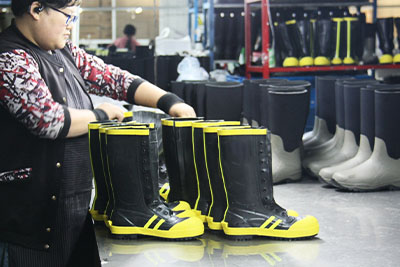
Las piezas uniformes y sin costuras se fabrican normalmente mediante moldeo por compresión o inyección. Para lograr un curado homogéneo del caucho en hormas de aluminio vulcanizado al vapor, se producen botas premium ensambladas a mano. La producción a gran escala se lleva a cabo en instalaciones con varias líneas de producción y mezcladoras internas, lo que permite un estricto control de calidad.
Trenboo opera actualmente 6 líneas de producción con 15 mezcladoras de caucho y sus respectivas vulcanizadoras. La planta tiene capacidad para gestionar grandes volúmenes diarios de pedidos B2B, a la vez que permite ajustar la calidad para diseños específicos que así lo requieran.
Técnicas de construcción que garantizan la impermeabilización a largo plazo
Incluso los mejores materiales deben ensamblarse de forma robusta para evitar fugas.
Diseños sin costuras y moldeados
La parte superior moldeada de una sola pieza, combinada con las fijaciones de la suela vulcanizada, forma una barrera continua contra el agua y la suciedad, sin orificios de costura ni líneas de pegamento que puedan debilitarse con el tiempo. El proceso de unión vulcanizada integra químicamente los componentes a nivel molecular.
Estrategias de sellado y refuerzo de juntas
Las costuras se pueden reforzar con cintas y selladores líquidos que se activan con el calor. Las lengüetas reforzadas de los zapatos con cordones están diseñadas para evitar que el agua penetre entre la parte superior y la plantilla. Las zonas de mayor desgaste, como el talón y la puntera, se refuerzan para prolongar la vida útil del calzado en uso profesional.
Diseño de la suela exterior para mayor tracción y durabilidad.
Nuestras suelas de caucho vulcanizado moldeado presentan patrones de rejilla únicos o surcos calandrados para una máxima tracción en superficies resbaladizas. Nuestras suelas híbridas están fabricadas con caucho combinado con espumas EVA ligeras que absorben los impactos. Estas ofrecen el equilibrio perfecto entre ligereza, absorción de impactos y resistencia al desgaste. También podemos diseñar patrones de surcos personalizados para adaptarnos a las necesidades específicas de cada terreno.

Tecnologías avanzadas que mejoran el rendimiento a prueba de agua
La innovación va más allá del caucho tradicional.
Membranas microporosas y soluciones de transpirabilidad
Las tecnologías de membrana, como las películas microporosas, permiten la transmisión de vapor al tiempo que bloquean el agua líquida, solucionando los problemas de condensación en recipientes totalmente sellados. botas de gomaEstas estructuras tipo botín se pueden insertar en carcasas exteriores de goma.
Tratamientos de superficie y sistemas multicapa
Los tratamientos repelentes al agua duraderos (DWR) pueden formularse para favorecer la formación de gotas y, al mismo tiempo, reducir la saturación del material. Asimismo, el calzado y los mocasines se fabrican con estructuras multicapa que incluyen una capa exterior de caucho, membranas, forros aislantes y tratamientos protectores.
Personalización e innovación en la producción
Ofrecemos soporte para el desarrollo OEM/ODM mediante hormas, estampados, texturas y logotipos personalizados, así como formulaciones de compuestos. La impresión por transferencia, los rodillos texturizados y las nuevas soluciones estructurales permiten diferenciar entre aplicaciones comerciales y profesionales.
Preguntas frecuentes
¿Qué diferencia hay entre una bota de lluvia impermeable y una bota resistente al agua?
Una bota impermeable está diseñada para soportar una alta presión hidrostática y está fabricada con materiales no porosos, mediante una construcción vulcanizada sin costuras o totalmente sellada. Ofrece un buen rendimiento en condiciones de mucha humedad y se mantiene impermeable.
¿Qué opciones de personalización ofrecen los fabricantes para los pedidos B2B?
Entre las opciones se incluyen diseños personalizados, colores, estampados, suelas, forros, logotipos y compuestos especializados para satisfacer los requisitos específicos de la marca y la aplicación.
Trenboo Trenboo es un fabricante y proveedor de botas de lluvia de caucho vulcanizado que ofrece soluciones de producción OEM y ODM confiables a distribuidores, minoristas, equipos de compras y marcas de calzado. Con líneas de producción consolidadas, capacidad de mezcla de caucho, experiencia en vulcanización, desarrollo de moldes personalizados, personalización de impresión y color, ingeniería de suelas, opciones de forro y soporte de control de calidad, Trenboo ayuda a los compradores a desarrollar botas de lluvia impermeables, botas de agua de moda, botas para exteriores, botas de lluvia para niños y calzado de seguridad para pedidos al por mayor y distribución internacional. Contacto Trenboo se reunirá con usted para hablar sobre las especificaciones de las botas de lluvia impermeables, los requisitos de diseño personalizado, el desarrollo de muestras, la cantidad mínima de pedido (MOQ), el plazo de entrega, las necesidades de certificación y la cooperación en la producción en masa.

 consultar
 Aplicación WhatsApp
 dejar mensaje
 arriba